
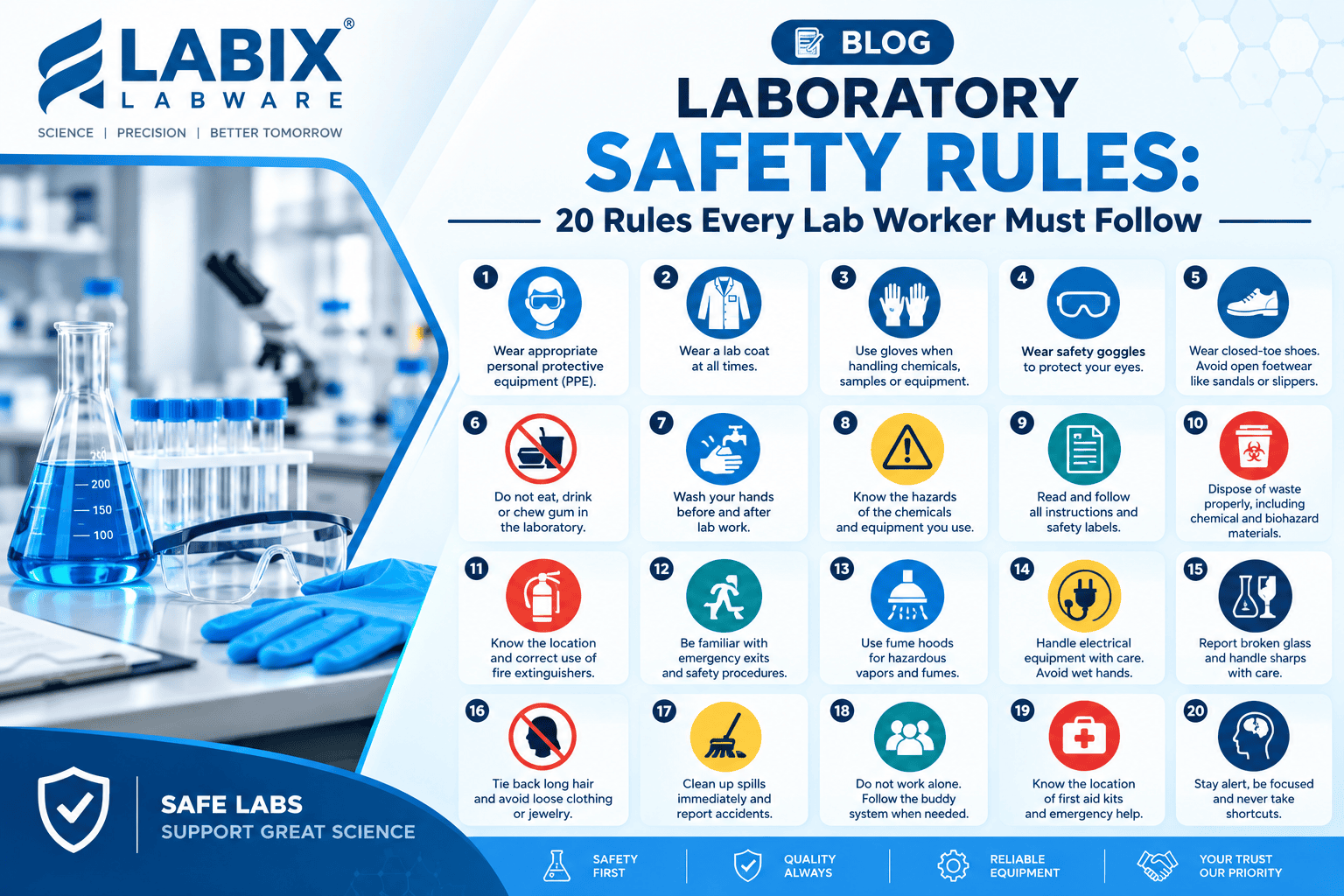
Laboratory safety rules are the standard practices that protect people, samples, and equipment from chemical, biological, physical, and electrical hazards. In short: understand the hazards before you begin, wear suitable protective equipment, handle chemicals, equipment, and waste as instructed, and know how to respond when something goes wrong. Whether you work in a research laboratory, a pharmaceutical facility, a hospital lab, or a school science room, these habits reduce risk and support reliable results. This guide sets out 20 practical rules in five groups: personal conduct and protective equipment, chemicals and glassware, equipment, biological safety and waste, and emergency readiness. Treat it as a baseline. Your institution’s risk assessment and local regulations always take priority.
Why Laboratory Safety Rules Matter
Laboratories bring together hazards that rarely appear in one place elsewhere: corrosive and flammable chemicals, biological materials, pressurised vessels, hot surfaces, sharp objects, and electrical equipment. A single lapse, such as an unlabelled bottle or a skipped glove check, can injure the person responsible and everyone nearby.
Safety rules also protect the work itself. Contaminated samples, damaged instruments, and interrupted experiments cost time and money, and in regulated settings such as pharmaceutical and clinical laboratories, poor practice can create compliance problems.
The rules below apply to everyone who enters the lab, including students, visitors, and contractors. No list can cover every situation, so combine these rules with a documented risk assessment, the safety data sheets (SDS) for the substances you use, and the manufacturer’s instructions for each instrument.
20 Laboratory Safety Rules Every Lab Worker Should Follow
Personal Conduct and Protective Equipment (Rules 1–5)
1. Understand the hazards before you start. Read the SDS for every chemical and review the procedure. If you cannot say what could go wrong and how you would respond, ask before proceeding.
2. Complete training and follow standard operating procedures (SOPs). Work only on procedures and equipment you have been trained to use, and never run unauthorised experiments. Where possible, avoid working alone with hazardous materials.
3. Wear appropriate personal protective equipment (PPE). At a minimum this usually means a lab coat, eye protection, and gloves suited to the task. Glove material matters: no single type protects against every chemical, so check the SDS and the glove manufacturer’s guidance.
4. Dress for the laboratory. Wear closed-toe shoes and long trousers or equivalent coverage, tie back long hair, and keep loose sleeves, jewellery, and dangling items away from equipment and flames.
5. Do not eat, drink, or apply cosmetics in the lab. Food and drink should never be stored with chemicals or samples. Keep your hands away from your face, and remove gloves and lab coats before leaving the work area.
Chemicals and Glassware (Rules 6–10)
6. Label every container. Include the contents, concentration where relevant, date, and the owner’s name. Unlabelled containers are a common cause of accidents and costly disposal problems.
7. Store chemicals correctly. Keep incompatible substances apart, for example acids away from bases and oxidisers away from flammable materials. Store flammables in appropriate cabinets and keep containers closed when not in use. Consult your institution’s chemical storage guidance for specific segregation requirements.
8. Use a fume hood for volatile, toxic, or odorous work. Keep materials well inside the hood, avoid cluttering it, and use the sash position recommended by the manufacturer or your safety officer.
9. Never pipette by mouth. Always use a pipette filler, pipettor, or other mechanical device.
10. Inspect and handle glassware with care. Check for cracks, chips, and star fractures before use, because damaged glassware can fail under heat, pressure, or vacuum. Dispose of broken glass in a designated container, never in general waste, and never pick it up with bare hands.
Equipment, Heat, Electricity, and Gas (Rules 11–14)
11. Never leave heat sources unattended. Hot plates, burners, heating mantles, and ovens should be monitored while in use. Keep flammable liquids well away from ignition sources and let hot items cool before handling.
12. Operate equipment only as the manufacturer intends. Read the manual and follow the SOP. With an autoclave, for example, use appropriate heat-resistant gloves and face protection, load only suitable materials, and allow pressure to fall before opening. With a laboratory centrifuge, balance the tubes, close the lid, and wait until the rotor stops completely before opening. Operating limits such as pressure, speed, and load capacity should always come from the equipment datasheet or manual.
13. Practise basic electrical safety. Check cords and plugs for damage, keep liquids away from electrical equipment, avoid overloading sockets, and report faulty equipment immediately. Remove it from service until it has been checked by a qualified person.
14. Secure and handle compressed gas cylinders properly. Keep cylinders upright and restrained, cap them when not in use, use the correct regulator for the gas, and move them with a suitable cart rather than rolling or dragging them.
Biological Safety, Sharps, and Waste (Rules 15–17)
15. Handle sharps carefully. Use needles, scalpels, and broken glass only when necessary, avoid recapping needles by hand, and place used sharps straight into a puncture-resistant sharps container.
16. Segregate and dispose of waste correctly. Chemical, biological, sharps, and general waste follow different routes. Never pour hazardous chemicals down the sink unless your procedures specifically allow it, and do not overfill waste containers. Biological work should follow the biosafety level requirements set by your institution and national guidance, such as the World Health Organization’s Laboratory Biosafety Manual.
17. Wash your hands and decontaminate surfaces. Wash hands after removing gloves and before leaving the lab. Clean benches and equipment at the end of each session and immediately after any spill, using disinfectants or cleaning agents appropriate to the contaminant.
Emergency Readiness and Housekeeping (Rules 18–20)
18. Know where emergency equipment is and how to use it. Locate the eyewash station, safety shower, fire extinguisher, first-aid kit, spill kit, fire alarm, and emergency exits before you begin work. Follow your institution’s procedure for how long to flush after chemical contact, and have equipment tested as required by the applicable standard or local regulation.
19. Report spills, injuries, and near misses promptly. Prompt reporting lets the lab fix the underlying cause before someone is seriously hurt. A near miss that nobody reports is a lesson wasted.
20. Keep the workspace tidy and exits clear. Store bags and personal items outside the work area, keep benches uncluttered, and never block aisles, exits, or access to emergency equipment.
Laboratory Safety Equipment and Controls to Have in Place
Rules work best when they are supported by physical controls. Engineering controls such as chemical fume hoods and biological safety cabinets reduce exposure at the source, and they depend on proper installation, regular maintenance, and certification according to local requirements. Emergency equipment, including eyewash stations, safety showers, extinguishers, and spill kits, should be accessible, clearly signposted, and checked on a schedule.
When you select or replace laboratory equipment, look beyond price. Consider the safety features and documentation your risk assessment calls for, such as pressure relief, door interlocks, and temperature controls. Ask the supplier for datasheets, operating manuals, and any certification documents for the specific model, and follow the manufacturer’s maintenance and calibration schedule once the equipment is in service.
Common Laboratory Safety Mistakes to Avoid
Most laboratory incidents come from routine lapses rather than unusual events. Watch for these:
- Skipping the SDS because a chemical seems familiar.
- Disabling or bypassing interlocks and guards to save time.
- Mixing or overfilling waste containers, which can cause dangerous reactions and disposal problems.
- Wearing gloves outside the lab, such as in corridors, offices, and break rooms, and spreading contamination.
- Ignoring near misses instead of reporting and learning from them.
- Using damaged equipment because a replacement is not immediately available.
Frequently Asked Questions
What is the difference between laboratory safety rules and laboratory safety precautions?
Safety rules are the specific behaviours expected of everyone in the lab, such as wearing eye protection or labelling containers. Safety precautions is a broader term covering the rules plus the controls and equipment that support them, such as fume hoods and emergency showers. In practice the two terms overlap, and a good safety programme includes both.
What is the minimum PPE required to enter a laboratory?
A lab coat, eye protection, and suitable footwear and clothing are the usual baseline, with gloves added for most hands-on work. The exact requirements depend on the hazards present, your institution’s policy, and local regulations, so follow your lab’s risk assessment.
What should I do first if a chemical spill occurs?
Alert people nearby, protect yourself, and check the SDS and your lab’s spill procedure. Small, low-hazard spills may be cleaned up by trained staff with the right spill kit. For large or hazardous spills, evacuate the area and notify your safety officer or emergency contact.
How often should laboratory staff receive safety training?
Staff should be trained before starting work and again whenever procedures, hazards, or equipment change. The required refresher frequency varies by institution and country, so check your employer’s policy and the regulations that apply to you.
Do safety rules differ between school labs and pharmaceutical or clinical labs?
The core principles, such as PPE, labelling, safe handling, and emergency readiness, are the same everywhere. What differs is the level of hazard, the regulatory framework, and the amount of documentation required. Each type of laboratory should follow the regulations and guidance that apply to it.
Conclusion
Safe laboratories rest on five habits: knowing the hazards, wearing the right protection, handling chemicals and waste carefully, using equipment as the manufacturer intends, and being ready for emergencies. Use these 20 laboratory safety rules as a checklist, then compare them with your own risk assessment, SOPs, and equipment manuals. If you are reviewing laboratory equipment for your facility, ask for datasheets and operating documentation for every model you consider. You can explore the range of laboratory, scientific, and educational equipment available from LABIX Industries as a starting point.





Add comment