
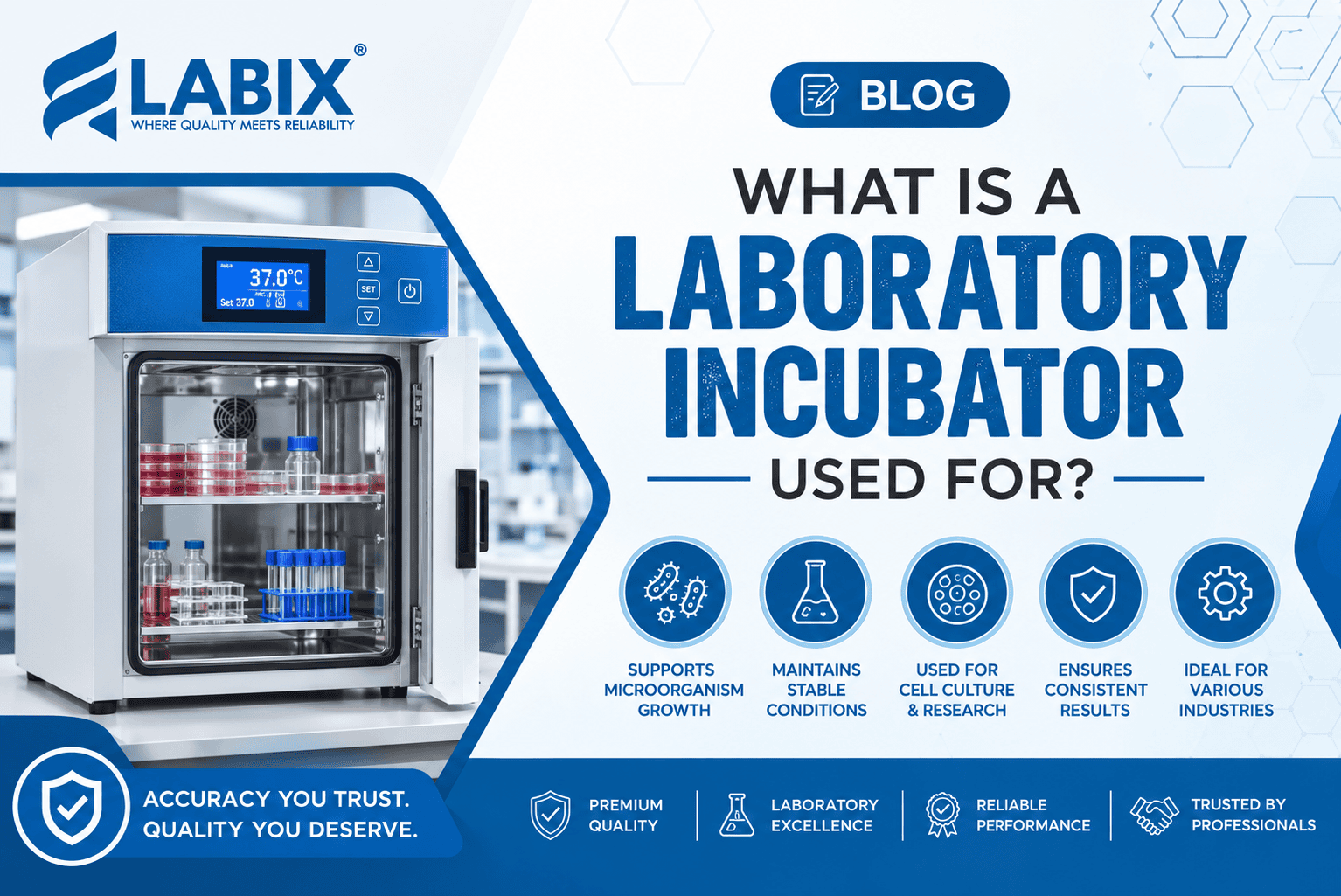
A laboratory incubator is used to maintain controlled environmental conditions, especially temperature, for growing microorganisms, supporting cell culture, and conducting biological and laboratory testing. Depending on its design, an incubator may also control carbon dioxide (CO₂), humidity, cooling, or shaking. These functions make laboratory incubators useful in microbiology, pharmaceutical research, environmental testing, biotechnology, and educational laboratories. Choosing the right incubator depends on the sample, the required conditions, and the procedure being performed. This guide explains the main laboratory incubator uses, different types, working principles, and important factors to consider when selecting equipment for laboratory applications.
What Is a Laboratory Incubator?
A laboratory incubator is an enclosed chamber designed to maintain specific environmental conditions for a defined period. It helps laboratories provide a stable environment for samples that need controlled conditions during growth, testing, or research.
Most standard laboratory incubators regulate temperature using a heating system, sensors, and an electronic controller. Depending on the model, additional features may include cooling, humidity control, CO₂ regulation, air circulation, or mechanical shaking.
Laboratory incubators are not all designed for the same purpose. A bacteriological incubator may be suitable for routine microbiological culture work, while a CO₂ incubator is designed for cell culture applications that require controlled gas conditions. A refrigerated or BOD incubator may be appropriate for procedures requiring temperatures below or around ambient conditions.
How Does a Laboratory Incubator Work?
The incubator’s sensor monitors the chamber temperature and sends information to the controller. The controller regulates the heating or cooling system to maintain the selected setting. Insulation and the chamber’s air circulation design help maintain suitable conditions throughout the interior.
Some specialized incubators also regulate CO₂ concentration, humidity, or shaking speed. The actual control range, accuracy, and available features depend on the equipment model. For reliable results, laboratories should follow the manufacturer’s instructions and the requirements of the relevant test method.
What Are the Main Uses of a Laboratory Incubator?
Laboratory incubator uses vary according to the equipment type, the sample being studied, and the procedure being performed. The following are some of the most common applications.
1. Microbiology and Bacterial Culture
One of the primary uses of a laboratory incubator is to provide controlled conditions for growing and studying microorganisms. Microbiology laboratories use incubators to maintain cultures at temperatures suitable for the organisms and methods under investigation.
These applications may include educational experiments, microbiological research, and selected quality-control procedures. Researchers can use the resulting cultures to observe microbial growth and conduct further analyses according to an established protocol.
The required incubation temperature and duration depend on the microorganism, culture medium, and test method. Laboratories must follow appropriate procedures to manage contamination risks and handle cultures safely.
2. Cell and Tissue Culture
Cell and tissue culture laboratories use specialized incubators to maintain environmental conditions that support the growth and study of biological cells. These applications are common in biotechnology, life sciences, and biomedical research.
Mammalian cell culture often requires controlled temperature, humidity, and CO₂ concentration. A CO₂ incubator helps maintain the gas conditions needed by certain culture media and cell systems.
Not every laboratory incubator is suitable for this purpose. Researchers should confirm that the selected model provides the necessary environmental controls and is compatible with their culture procedures.
3. Pharmaceutical Research and Quality-Control Testing
Pharmaceutical laboratories use incubators for selected microbiological procedures, research activities, and testing workflows that require controlled incubation conditions.
For example, an incubator may support a prescribed microbial culture step or a laboratory investigation involving biological samples. The equipment must provide conditions appropriate to the method being followed.
An incubator alone does not establish that a pharmaceutical product is sterile, safe, or compliant with applicable requirements. Laboratories must use validated procedures, suitable equipment, trained personnel, and appropriate documentation when required by their testing standards.
4. Environmental and Water Quality Testing
Environmental laboratories may use specialized incubators for biochemical oxygen demand (BOD) testing. BOD analysis helps assess the amount of dissolved oxygen consumed by microorganisms as they break down biodegradable organic matter in a water sample under specified test conditions.
A BOD incubator maintains the temperature required by the relevant procedure during the test period. This supports water-quality investigations involving wastewater, environmental samples, and other appropriate applications.
BOD incubators may also be used for selected microbiological and biological studies that require controlled temperatures. The correct operating conditions should always be determined by the applicable method rather than assumed to be the same for every test.
5. Educational and General Biological Research
Schools, colleges, universities, and research institutions use laboratory incubators for appropriate biological experiments and demonstrations.
In teaching laboratories, incubators help students understand how environmental conditions influence biological processes. In research settings, they help maintain defined conditions so that experiments can be conducted consistently.
Applications vary by laboratory and may include microbial growth studies, selected biological investigations, and other procedures requiring controlled incubation. The incubator must be appropriate for the samples, experiment, and laboratory safety requirements.
What Are the Different Types of Laboratory Incubators?
Different laboratory tasks require different environmental conditions. Understanding the main types of incubators helps laboratories select equipment suited to their applications.
1. Bacteriological Incubator
A bacteriological incubator maintains a controlled temperature for microbiological culture work. It provides a suitable environment for growing and studying microorganisms.
Laboratories in microbiology, research, education, and pharmaceutical fields use bacteriological incubators for various applications. Before choosing one, check the temperature range, chamber capacity, and control features to ensure they meet your laboratory’s requirements.
LABIX Industries lists a bacteriological incubator under its laboratory equipment range. Buyers should review the product’s published specifications to determine whether it meets their particular laboratory requirements.
2. CO₂ Incubator
A CO₂ incubator is designed for applications that require controlled carbon dioxide concentration, commonly alongside temperature and humidity regulation.
It is frequently used for mammalian cell culture and other specialized biological research. CO₂ control can help maintain the required conditions for culture media that depend on a carbon dioxide–bicarbonate buffering system.
Before selecting one, researchers should confirm the required gas concentration, temperature range, humidity features, contamination-control design, and chamber capacity.
3. BOD or Refrigerated Incubator
A BOD incubator is designed to maintain controlled temperatures for biochemical oxygen demand testing and other suitable laboratory procedures. Many models include cooling as well as heating, allowing operation at temperatures below ambient conditions.
These incubators are particularly relevant to environmental and water-testing laboratories. Depending on the model, they may also support selected microbiological, biological, and research applications.
The operating range and temperature stability should be checked against the specific test method.
4. Shaking Incubator
A shaking incubator combines controlled incubation with mechanical movement. The shaking action helps mix samples and can support selected culture and research applications where agitation is required.
Shaking incubators are used in areas such as microbiology, biotechnology, and cell or microbial culture workflows, depending on the configuration.
LABIX Industries offers an orbital shaking incubator, model LBX-107. Its published specifications include adjustable shaking speed and temperature control. Buyers should verify the available capacity and operating conditions for their intended use.
What Factors Should You Consider When Choosing a Laboratory Incubator?
Selecting the right laboratory incubator involves more than comparing prices or chamber sizes. The equipment must meet the environmental and operational requirements of the intended application.
Temperature Range and Control
Check the required operating temperature and the manufacturer’s stated control accuracy and temperature uniformity. These characteristics are important when a procedure depends on stable conditions throughout the chamber.
Chamber Capacity
Consider the number and size of samples, the space needed for containers, and the available shelf arrangement. Avoid selecting a chamber based only on its total volume without considering usable space.
Environmental Control Requirements
Determine whether the application requires standard temperature control, refrigeration, CO₂ regulation, humidity control, or shaking. A standard incubator should not be assumed to provide specialized functions.
Monitoring and Maintenance
Review the available temperature display, alarms, recording options, calibration requirements, and service procedures. For regulated or quality-sensitive workflows, confirm the documentation and monitoring capabilities required by the relevant standards.
Application Compatibility
Match the incubator’s specifications to the sample type, laboratory protocol, and operating environment. Consult the product documentation or manufacturer when any requirement is unclear.
Safe Operation and Routine Maintenance of Laboratory Incubators
Proper operation and maintenance help laboratories preserve suitable incubation conditions and reduce avoidable equipment problems.
- Follow the operating manual: Use the manufacturer’s instructions for installation, operation, cleaning, and maintenance.
- Keep the chamber clean: Use cleaning or disinfection methods compatible with the incubator and the intended application.
- Monitor operating conditions: Check the displayed temperature and any other controlled parameters according to laboratory procedures.
- Avoid overcrowding: Arrange samples so that the chamber’s designed airflow is not unnecessarily obstructed.
- Inspect equipment regularly: Check door seals, shelves, alarms, and error messages as part of routine maintenance.
- Follow calibration requirements: Arrange checks and calibration according to the laboratory’s quality procedures and the manufacturer’s recommendations.
Laboratories working with microorganisms, cell cultures, or potentially hazardous samples should also follow their established biosafety and contamination-control procedures. Routine cleaning alone does not guarantee sterility or eliminate every contamination risk.
Frequently Asked Questions
What is the main purpose of a laboratory incubator?
The main purpose of a laboratory incubator is to maintain controlled environmental conditions for biological or laboratory procedures. Common applications include microbial culture growth, cell culture, selected research activities, and tests that require stable incubation conditions.
What temperature is used in a laboratory incubator?
The required temperature depends on the organism, sample, test method, and incubator type. There is no single temperature suitable for every application. Laboratories should follow the relevant protocol and confirm that the equipment can maintain the required conditions.
What is the difference between a laboratory incubator and an oven?
A laboratory incubator is generally used to maintain controlled conditions for incubation, often involving biological samples. A laboratory oven is typically designed for specified heating, drying, or related thermal processes. Their intended uses and operating limits are different, so one should not automatically replace the other.
Can a laboratory incubator be used for cell culture?
Yes, if the incubator is designed for the particular cell-culture application. Some cell cultures require controlled CO₂ and humidity in addition to temperature. Researchers should check the equipment specifications and follow their approved culture protocol.
How do I choose the right laboratory incubator?
Start by identifying the application and the required temperature, capacity, and environmental controls. Then compare the available monitoring features, cleaning requirements, maintenance needs, and manufacturer documentation. The selected model should meet the actual laboratory procedure rather than simply offer the largest number of features.
Conclusion
Laboratory incubators support a wide range of applications, from microbiological culture and cell research to selected pharmaceutical procedures and BOD testing. The right equipment depends on the sample, the required environmental conditions, and the laboratory method. Understanding the differences between bacteriological, CO₂, refrigerated, and shaking incubators can help laboratories make more informed equipment decisions. LABIX Industries provides options such as bacteriological and orbital shaking incubators. Review the available product specifications and compare them with your application requirements before selecting equipment for your laboratory.



Add comment