
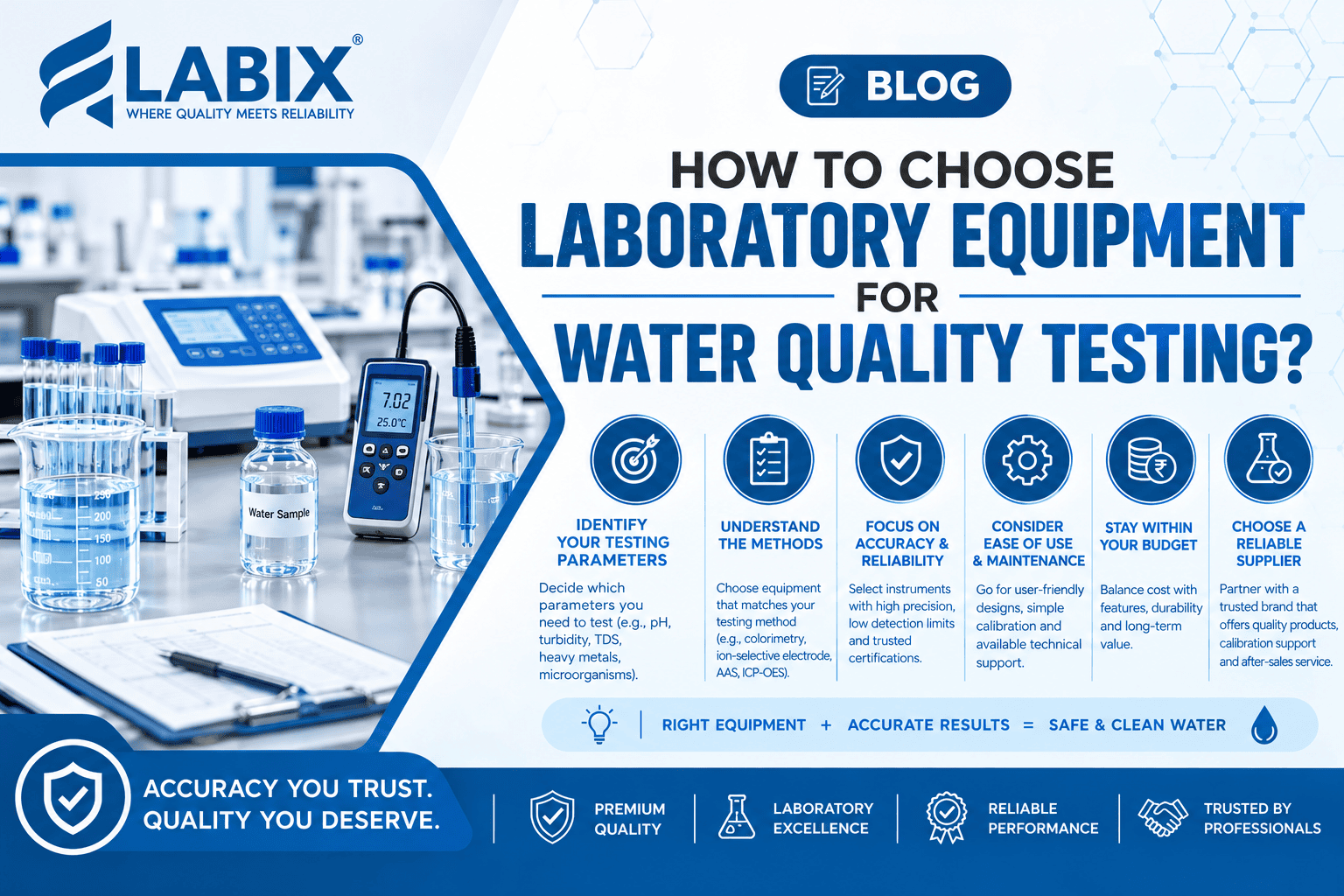
Water quality testing requires suitable laboratory equipment to measure physical, chemical, and other relevant characteristics of water samples. Choosing the right instruments depends on the parameters being tested, the type of water, required measurement accuracy, sample volume, and applicable testing methods. By evaluating these factors before purchasing, laboratories can select equipment that supports reliable results, efficient workflows, and long-term operational needs.
What Is Water Quality Testing and Why Does Equipment Selection Matter?
Water quality testing is the process of examining water to understand its characteristics and determine whether it meets specific requirements for its intended use. Testing may be performed on drinking water, groundwater, surface water, wastewater, industrial process water, or water used in research and education.
Different applications require different measurements. For example, a laboratory investigating changes in water acidity may need a pH meter, while a facility monitoring suspended particles may require a turbidity meter. A broader water analysis programme may need several instruments and laboratory accessories.
Selecting appropriate water quality testing laboratory equipment matters for several reasons:
- Reliable measurements: Instruments must be suitable for the parameter and measurement range being investigated.
- Consistent results: Appropriate calibration and operating procedures help laboratories obtain comparable measurements over time.
- Efficient workflows: Equipment should match the number of samples and the frequency of testing.
- Method compatibility: Instruments and accessories must support the chosen testing method.
- Cost management: Considering maintenance, calibration, consumables, and training helps estimate the overall cost of ownership.
The objective is not simply to purchase more instruments. It is to identify the equipment needed for the laboratory’s actual testing responsibilities.
Identify Which Water Quality Parameters You Need to Measure
Before comparing equipment, prepare a list of the water quality parameters your laboratory needs to analyse. Each parameter provides different information, so one instrument cannot replace every other testing method.
1. pH
pH indicates how acidic or alkaline a water sample is. It is commonly measured in environmental monitoring, water treatment, industrial processes, and educational laboratories.
A pH meter for water testing typically uses a suitable electrode to measure the sample’s pH. When selecting one, consider the required measurement range, resolution, accuracy, calibration procedure, electrode compatibility, and temperature compensation features.
Explore the LABIX Industries pH meter range to review available options.
2. Electrical Conductivity
Electrical conductivity indicates how readily water conducts an electrical current. It is influenced by the concentration and types of dissolved ions present in the sample.
A conductivity meter can help monitor changes in water composition, process water, and laboratory water systems. Choose a model with a suitable measurement range and probe for the expected sample conditions. Temperature compensation may also be important because conductivity changes with temperature.
Conductivity does not identify individual dissolved substances. Additional testing may be needed to determine which ions are present.
3. Total Dissolved Solids (TDS)
Total dissolved solids refers to the dissolved substances present in water, commonly expressed in milligrams per litre (mg/L) or parts per million (ppm).
Many handheld and laboratory TDS meters estimate TDS from electrical conductivity using a conversion factor. The result is therefore an estimate rather than a direct measurement of every dissolved substance.
When selecting a TDS meter, check the measurement range, conversion settings, temperature compensation, and whether the instrument is suitable for your testing method.
4. Turbidity
Turbidity describes the cloudiness of water caused by suspended particles that scatter light. It is relevant to drinking-water treatment, environmental monitoring, and wastewater assessment.
A turbidity meter measures light scattering or attenuation according to its measurement design. Before purchasing, check the applicable method, measurement range, resolution, calibration requirements, and compatibility with the sample containers used.
Turbidity is not the same as colour or total suspended solids, although these characteristics may sometimes be related.
5. Dissolved Oxygen
Dissolved oxygen (DO) is the amount of oxygen dissolved in water. It is important in aquatic ecosystem studies, wastewater treatment, and environmental analysis.
A dissolved oxygen meter measures this parameter using a compatible sensor. Consider the required range, sensor technology, calibration requirements, temperature compensation, and whether measurements will be taken in the laboratory or directly in the field.
6. Chemical Oxygen Demand (COD)
Chemical oxygen demand is a measurement used to estimate the amount of oxygen equivalent required to chemically oxidise substances in a water sample under specified test conditions. It is widely used in wastewater monitoring and treatment assessment.
COD testing may require digestion equipment, suitable reagents, glassware, and an appropriate measurement procedure. A COD digestion system supports the digestion stage, but the complete analysis may also require additional equipment and measurement steps.
The LABIX Industries COD digestion system category is a useful starting point when evaluating equipment for this application.
Which Types of Laboratory Equipment Should You Compare?
The appropriate combination of instruments depends on the scope of your water testing programme. The following table provides a practical overview.
| Equipment | Main purpose | Common applications |
| pH meter | Measures acidity or alkalinity | Water treatment, research, routine monitoring |
| Conductivity meter | Measures electrical conductivity | Process water, environmental analysis |
| TDS meter | Estimates dissolved solids from conductivity in many models | Routine water checks and process monitoring |
| Turbidity meter | Measures water cloudiness | Water treatment and environmental monitoring |
| Dissolved oxygen meter | Measures dissolved oxygen | Aquatic studies and wastewater analysis |
| COD digestion system | Supports sample digestion for COD testing | Wastewater and industrial water analysis |
| Water and soil analysis kit | Supports selected analyses, depending on its included components | Field, educational, or routine testing |
Do not assume that every kit includes the same parameters, reagents, accessories, or measurement capabilities. Review the product specifications and supplied components before deciding whether a kit meets your requirements.
You can begin by reviewing the LABIX Industries product range and comparing the equipment categories relevant to your testing plan.
Key Specifications to Check Before Buying
Once you know which parameters need to be measured, compare the specifications of suitable instruments. Product names alone are not enough to determine whether an instrument will meet your laboratory’s requirements.
Measurement range and resolution
The measurement range indicates the values an instrument is designed to measure. Resolution refers to the smallest change displayed by the instrument.
Select a range that covers your expected samples without sacrificing the ability to observe meaningful changes. A very broad range is not automatically the best choice if most of your samples fall within a narrow interval.
Accuracy and repeatability
Accuracy describes how close a measurement is to the accepted or reference value. Repeatability describes how closely repeated measurements agree under the same conditions.
Check the manufacturer’s stated performance specifications and confirm that they are suitable for the intended method. Do not compare instruments using different specifications as if they were equivalent.
Calibration requirements
Calibration helps establish the relationship between an instrument’s response and known reference standards. Different instruments require different calibration procedures.
Consider the availability of appropriate calibration standards, the time needed for calibration, the procedure’s complexity, and any documentation required by your laboratory’s quality system.
Temperature compensation
Temperature can affect measurements such as pH and electrical conductivity. Depending on the instrument and method, temperature compensation may improve the suitability of readings for comparison.
However, automatic temperature compensation does not eliminate every temperature-related effect. Follow the instrument manual and the selected analytical method.
Probe, sensor, and sample compatibility
The probe or sensor must be suitable for the samples being tested. Factors such as sample temperature, chemical composition, suspended particles, and expected contamination can affect sensor performance and service life.
Also check whether replacement probes, electrodes, cables, sample cells, and other required accessories are available.
Display, data handling, and connectivity
Some laboratories need only a straightforward display, while others require stored readings, timestamps, data transfer, or integration with laboratory information systems.
Choose data-handling features based on actual workflow needs. If results must be traceable, verify how the instrument records, exports, and protects measurement data.
Consider Sample Collection, Preparation, and Handling
Reliable results depend on more than the instrument itself. Incorrect sample collection, unsuitable containers, contamination, or delays can affect measurements before testing begins.
Use suitable sample containers
Choose containers appropriate for the parameter and analytical method. Some tests require clean containers, while others may need specialised containers or preservation procedures. Follow the relevant sampling protocol rather than using one container type for every analysis.
Prevent contamination
Clean sampling tools and suitable handling practices help reduce the risk of introducing unwanted substances. Where necessary, use separate equipment for different samples and follow laboratory cleaning procedures.
Consider holding time and preservation
Some water quality parameters can change after collection. Temperature, exposure to air or light, biological activity, and chemical reactions may influence results.
Follow the applicable method for sample preservation, storage temperature, and maximum holding time. Do not assume that every sample can be stored for the same duration.
Plan for sample throughput
Estimate how many samples will be processed during a typical day or week. A laboratory handling a small number of research samples may have different needs from a facility conducting routine monitoring across many locations.
The number of samples affects the required instrument capacity, preparation equipment, staff time, and space available on the laboratory bench.
Calibration, Maintenance, and Laboratory Quality Requirements
Regular maintenance and appropriate calibration help keep water testing instruments suitable for their intended use. A purchasing decision should account for these activities from the beginning.
Establish a calibration schedule
Calibration frequency depends on the instrument, testing method, manufacturer’s recommendations, usage conditions, and laboratory quality requirements. Some workflows may also require calibration checks before or during a testing session.
Use appropriate standards and document calibration results according to the laboratory’s procedures.
Follow cleaning and storage instructions
Electrodes, probes, sensors, and sample cells may require specific cleaning and storage conditions. Incorrect storage can shorten sensor life or affect measurement performance.
Follow the manufacturer’s instructions and train users to handle sensitive components properly.
Check service and replacement availability
Before purchasing, find out whether replacement parts, sensors, consumables, and technical support are available. Consider the expected service life and the practical process for repair or recalibration.
Match equipment to the required method
If testing is performed for regulatory reporting, accreditation, contractual requirements, or official compliance assessment, the instrument must be suitable for the specified analytical method. Equipment alone does not establish compliance.
Confirm the relevant method, quality-control procedures, reporting limits, and any applicable jurisdiction-specific requirements before selecting the final setup.
How to Compare Total Cost and Laboratory Requirements
The initial purchase price is only one part of the cost of water testing laboratory equipment. A more useful comparison includes the expenses associated with using and maintaining the instrument throughout its service life.
Consider the following factors:
- Purchase cost: The price of the instrument and the accessories required for normal operation.
- Consumables: Reagents, calibration solutions, sample cells, and other recurring supplies.
- Maintenance: Cleaning, replacement sensors, servicing, and repairs.
- Calibration: Standards, calibration services, and staff time.
- Training: Time needed to train laboratory personnel in correct operation and quality-control procedures.
- Infrastructure: Available bench space, power supply, environmental conditions, and any additional equipment needed.
- Throughput: The number of samples the instrument can support within the required working schedule.
Create a comparison sheet listing each requirement and the corresponding specifications of shortlisted instruments. Mark essential requirements separately from optional features. This helps prevent unnecessary purchases while ensuring that important testing needs are not overlooked.
Also consider the experience of the people who will use the equipment. A technically advanced instrument may not be the most practical choice if its operation, maintenance, or data workflow does not suit the laboratory.
How to Match LABIX Industries Equipment to Your Testing Needs
LABIX Industries provides laboratory equipment across several categories, including analytical instruments relevant to water testing. Start by identifying the parameters you need to measure, then review the relevant product categories and specifications.
A practical selection process is:
- Define the testing objective. Decide whether the laboratory will conduct routine screening, environmental monitoring, research, wastewater analysis, or testing for a specified compliance method.
- List the required parameters. Separate measurements such as pH, conductivity, TDS, turbidity, dissolved oxygen, and COD.
- Shortlist the relevant instruments. Review product categories and compare the available measurement ranges, accuracy specifications, accessories, and operating requirements.
- Check the complete workflow. Determine whether sample preparation equipment, reagents, standards, containers, or additional instruments are needed.
- Confirm technical suitability. Verify the product specifications and compatibility with the required analytical method before ordering.
Visit the LABIX Industries products page to explore the available range. For more specific requirements, review the pH meter category and COD digestion system category.
The final selection should be based on verified product specifications and the laboratory’s documented requirements, rather than on general product descriptions alone.
Frequently Asked Questions
1. What equipment is needed for a water quality testing laboratory?
The equipment depends on the parameters being tested. Common options include pH meters, conductivity meters, turbidity meters, dissolved oxygen meters, and TDS meters. COD analysis may require digestion equipment and additional testing supplies. Sample collection tools, calibration standards, suitable containers, and other accessories may also be necessary.
2. Which instrument is used to test the pH of water?
A pH meter with a suitable electrode is commonly used to measure the pH of water. The instrument should be appropriate for the expected sample conditions and measurement range. Calibration with suitable buffer solutions and following the manufacturer’s instructions help support reliable readings.
3. Is a TDS meter enough to determine water quality?
No. A TDS meter alone cannot provide a complete assessment of water quality. Many TDS meters estimate dissolved solids from electrical conductivity, and the reading does not identify individual substances or establish whether water is safe to drink. Other physical, chemical, and microbiological tests may be necessary depending on the intended use.
4. What is the difference between a conductivity meter and a turbidity meter?
A conductivity meter measures how readily a sample conducts electrical current, which is influenced by dissolved ions. A turbidity meter measures the cloudiness of water caused by suspended particles that scatter light. They assess different characteristics and cannot be used interchangeably.
5. How do I choose equipment for drinking-water testing?
Begin by identifying the applicable drinking-water requirements and the parameters that must be tested. Consider the relevant analytical methods, instrument performance, calibration, sample handling, and quality-control procedures. Drinking-water safety may require chemical and microbiological analysis in addition to routine measurements such as pH or turbidity.
6. How often should water testing laboratory equipment be calibrated?
There is no single calibration interval suitable for every instrument. Follow the manufacturer’s recommendations, the analytical method, and your laboratory’s quality system. Calibration checks may be required before use, at specified intervals, or when instrument performance is in doubt. Keep appropriate records of calibration and quality-control checks.
Conclusion
Choosing the right water quality testing laboratory equipment starts with understanding which parameters need to be measured and why. Compare measurement range, accuracy, calibration requirements, sample compatibility, maintenance, and total cost before making a purchase. Laboratories should also consider sample handling, testing volume, staff training, and the analytical methods they need to follow.
By evaluating these factors systematically and checking verified product specifications, laboratories can build a suitable testing setup for routine monitoring, research, environmental analysis, or wastewater assessment. The most effective equipment selection is one that meets the laboratory’s actual requirements and supports consistent, well-documented results.


Add comment