
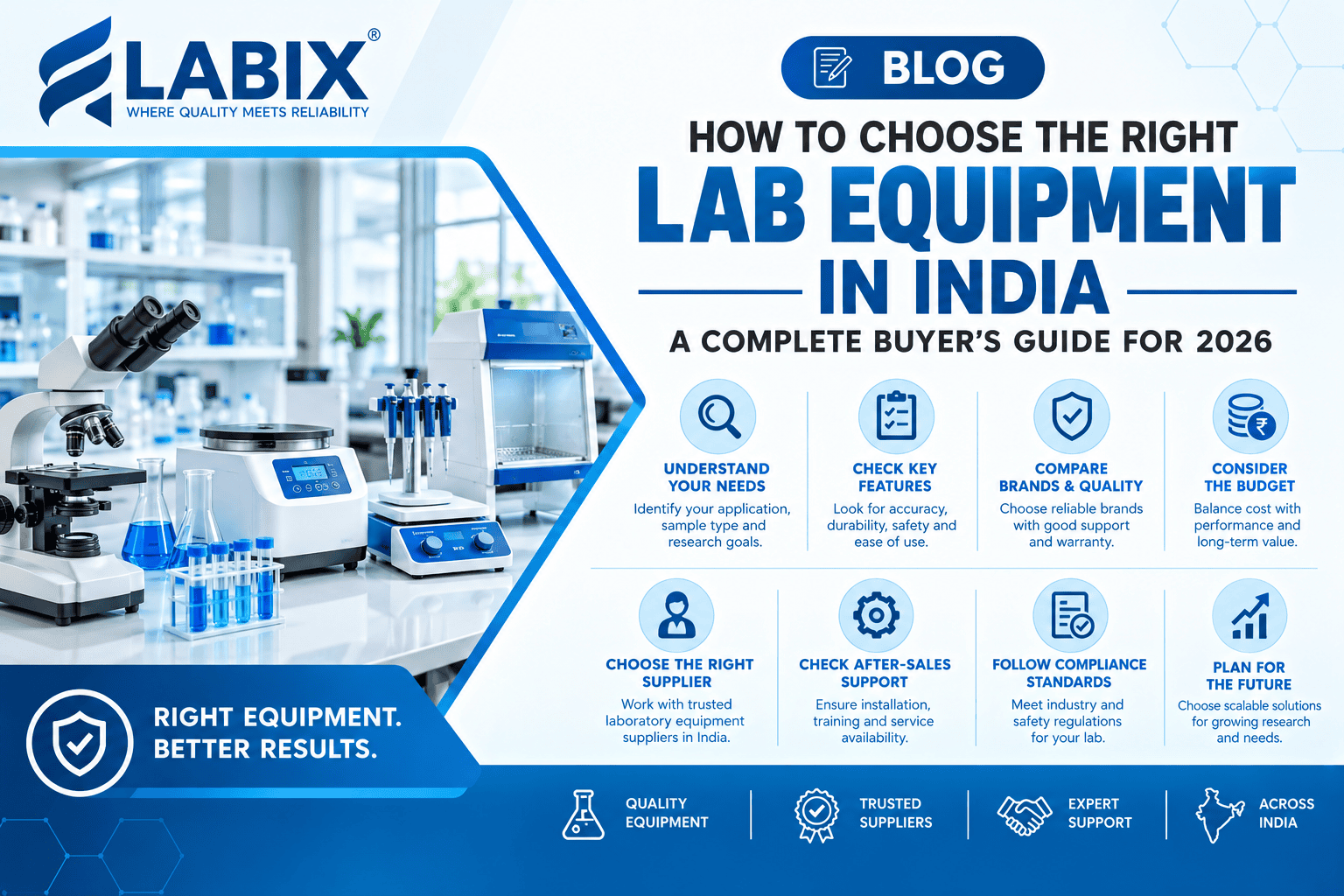
Choosing lab equipment in India starts with three steps: define your application, confirm the technical specifications you need, and check what documentation and support the supplier provides. Price matters, but it should come after these checks. A wrong purchase can mean unreliable results, repeated downtime, and money spent on a replacement.
This guide is for laboratory managers, procurement teams, researchers, educators, and international buyers. It explains how to choose lab equipment step by step, covering requirements, specifications, supplier checks, budgeting, and common mistakes. Use it as a practical checklist before you request quotations.
What Counts as Lab Equipment, and Why the Choice Matters
Laboratory equipment covers a wide range of instruments and apparatus used for testing, research, teaching, and production support. Common groups include:
- Heating and sterilisation equipment, such as ovens and autoclaves
- Separation equipment, such as centrifuges
- Analytical and measurement instruments, such as pH meters and balances
- Glassware, consumables, and accessories
- Educational apparatus for physics, chemistry, and biology teaching
The right choice affects measurement accuracy, operator safety, and daily productivity. A well-matched instrument fits your workflow and keeps results consistent. A poorly matched one can slow the lab down or produce data you cannot rely on.
Step 1: Define Your Requirements Before You Compare Products
The most common buying mistake is comparing models before the requirement is clear. Start with your own needs, then look at products.
Application and Sample Type
Write down what the equipment will be used for. Note the sample type, sample volume, and how many samples you handle per day or per batch. Also decide whether the equipment will run continuously or only occasionally. A teaching lab running short demonstrations has very different needs from a quality control lab running daily tests.
Operating Environment and Infrastructure
Check the space and utilities available. Consider bench size, power supply and voltage, ventilation, water supply, and ambient temperature. Some equipment needs a dedicated circuit or extra clearance. Always confirm installation requirements in the product datasheet or manual before you order.
Compliance and Documentation Needs
Find out whether your lab follows a quality system or regulatory framework. Pharmaceutical and healthcare laboratories often need documented equipment records, while research and teaching labs may follow institutional rules. Check the applicable guidance, such as GMP requirements or accreditation standards, from official sources, and confirm with your quality team which documents you will need from the supplier.
Key Specifications and Features to Compare
Once your requirement is clear, compare equipment on the specifications that matter for your work.
Capacity, Range, Accuracy, and Resolution
These terms are often confused. Accuracy is how close a reading is to the true value. Resolution is the smallest change the instrument can display. Repeatability is how consistent results are across repeated measurements. A display that shows more decimal places does not automatically mean a more accurate instrument, so ask for accuracy figures in the datasheet.
For example, when you compare a microprocessor pH meter with other models, check the stated range, resolution, and accuracy for your samples, and ask how calibration is performed.
Materials and Build Quality
Ask what the equipment is made of, especially the parts that touch samples or chemicals. Stainless steel, borosilicate glass, and various plastics each behave differently with heat and chemicals. Check chemical compatibility for your specific samples, and confirm material details in the datasheet instead of assuming.
Controls, Safety Features, and Ease of Use
Look at how the equipment is operated. Digital controls, timers, and clear displays reduce operator error. Depending on the equipment, check for safety features such as over-temperature protection or pressure-related safeguards. Ask how easy it is to clean and maintain, since this affects both safety and equipment life.
Calibration, Spare Parts, and Maintenance
Ask how the equipment is calibrated, how often, and who can do it. Also ask whether spare parts and consumables are easy to get. Calibration practice is usually guided by standards such as ISO/IEC 17025 and by accreditation frameworks like NABL in India, so confirm what your lab actually needs.
A simple comparison table can help you review options side by side:
| Check | What to ask |
|---|---|
| Range and accuracy | Are they suitable for my samples? |
| Materials | Are they compatible with my chemicals? |
| Safety features | What protections are included? |
| Calibration | How often, and who performs it? |
| Spare parts | Are they available locally? |
Choosing Lab Equipment by Type of Laboratory
Different labs have different priorities, so the same equipment may be judged differently.
Research and Analytical Labs
Precision, repeatability, and data reliability come first. Equipment such as analytical instruments and laboratory centrifuges should be assessed on stated accuracy and performance ranges, and on whether they fit the specific method you follow.
Pharmaceutical Labs
Documentation, cleanability, and consistency are key. Ask suppliers about the records and manuals they provide, and check these against your internal quality requirements and the applicable regulatory guidance.
Healthcare and Clinical Settings
Reliability and safe operation matter most. Sterilisation equipment, for example, should be selected according to capacity, operating parameters, and the manufacturer’s usage instructions. Follow the manufacturer’s guidance and your facility’s protocols.
Schools, Colleges, and Universities
Durability, ease of use, and safety for students are the main concerns. Educational labs often need multiple identical setups for different batches, so budget planning and ease of replacement are important. Equipment for physics, chemistry, and biology labs should also be easy to maintain.
How to Evaluate Lab Equipment Suppliers in India
A good specification means little without a dependable supplier. Check these points before you place an order.
Verify the Supplier
Start by understanding who you are buying from and what proof they can show.
Manufacturer, Trader, or Distributor?
Ask the supplier directly whether they manufacture the equipment or resell it. This affects customisation options, lead time, spare parts, and who is responsible when something goes wrong.
Documentation and Quality Evidence
Request the datasheet, user manual, warranty terms, and any test or calibration records relevant to your purchase. If a supplier mentions a certification, ask for the document. Do not assume certificates exist.
Check Support and Logistics
Next, confirm what happens after the order is placed.
Installation, Training, and After-Sales Support
Find out whether installation help and operator training are included. Ask about service response time and how spare parts are supplied. Strong after-sales support often matters more than a small price difference.
Considerations for Export and International Buyers
If you are buying from outside India, discuss packaging, shipping mode, and export paperwork early. Confirm voltage and plug compatibility for your country, and check current export regulations with official sources and your supplier. Ask for a clear quotation that states delivery terms.
Budget, Total Cost of Ownership, and Value
The purchase price is only part of the cost. Total cost of ownership also includes installation, consumables, maintenance, calibration, spare parts, and downtime.
A lower-cost unit can be a sensible choice for teaching demonstrations or low-volume use. For regulated testing or high-throughput work, a more robust instrument with better support may be the better investment. Compare quotations on the same terms, including warranty, delivery, and what is included in the price.
Common Mistakes to Avoid When Buying Lab Equipment
- Buying on price alone and ignoring support and documentation
- Skipping the space and utilities check, which causes installation delays
- Not confirming spare parts and service access before ordering
- Ignoring the datasheet and manual, which hides limits and requirements
- Over-specifying or under-specifying for the actual application
A short pre-purchase review with your lab team usually catches these problems early.
Frequently Asked Questions
How do I choose the right lab equipment for my laboratory?
Start with your application, sample type, and daily workload. Then compare specifications such as range, accuracy, and materials, and check safety features and supplier support. Finally, compare the total cost, not just the purchase price.
What documents should I ask a lab equipment supplier for?
Ask for the datasheet, user manual, warranty terms, and calibration or test records where applicable. If the supplier claims a certification, request the document itself. Requirements differ by lab, so confirm with your quality team.
Is it better to buy from a manufacturer or a distributor?
Both can work. Manufacturers may offer more customisation and direct technical answers, while distributors may offer wider brand choice. Ask each one about warranty, spare parts, and service responsibility before deciding.
How often should lab equipment be calibrated and maintained?
It depends on the equipment, how often it is used, and your quality system. Follow the manufacturer’s manual and your lab’s standard operating procedures, and keep a record of every calibration.
Can international buyers source lab equipment from India?
Yes, many buyers do. Discuss packaging, shipping, export documents, and voltage compatibility with the supplier at the quotation stage, and check current rules with official sources.
What should schools and colleges prioritise when buying lab equipment?
Prioritise safety, durability, and ease of use for students. Also plan for enough identical setups per batch, and check that maintenance and replacement parts are easy to get.
Conclusion
Buying lab equipment in India works best when you follow a clear order: define your requirement, compare the specifications that matter, check the supplier’s documentation and support, and then review the total cost. This approach reduces risk and helps your equipment stay useful for years.
When you are ready to shortlist options, request datasheets and quotations from two or three suppliers and compare them on the same terms. You can explore the laboratory, educational, and pharmaceutical equipment range from LABIX Industries and contact the team for product details and quotations.

Add comment