
Introduction
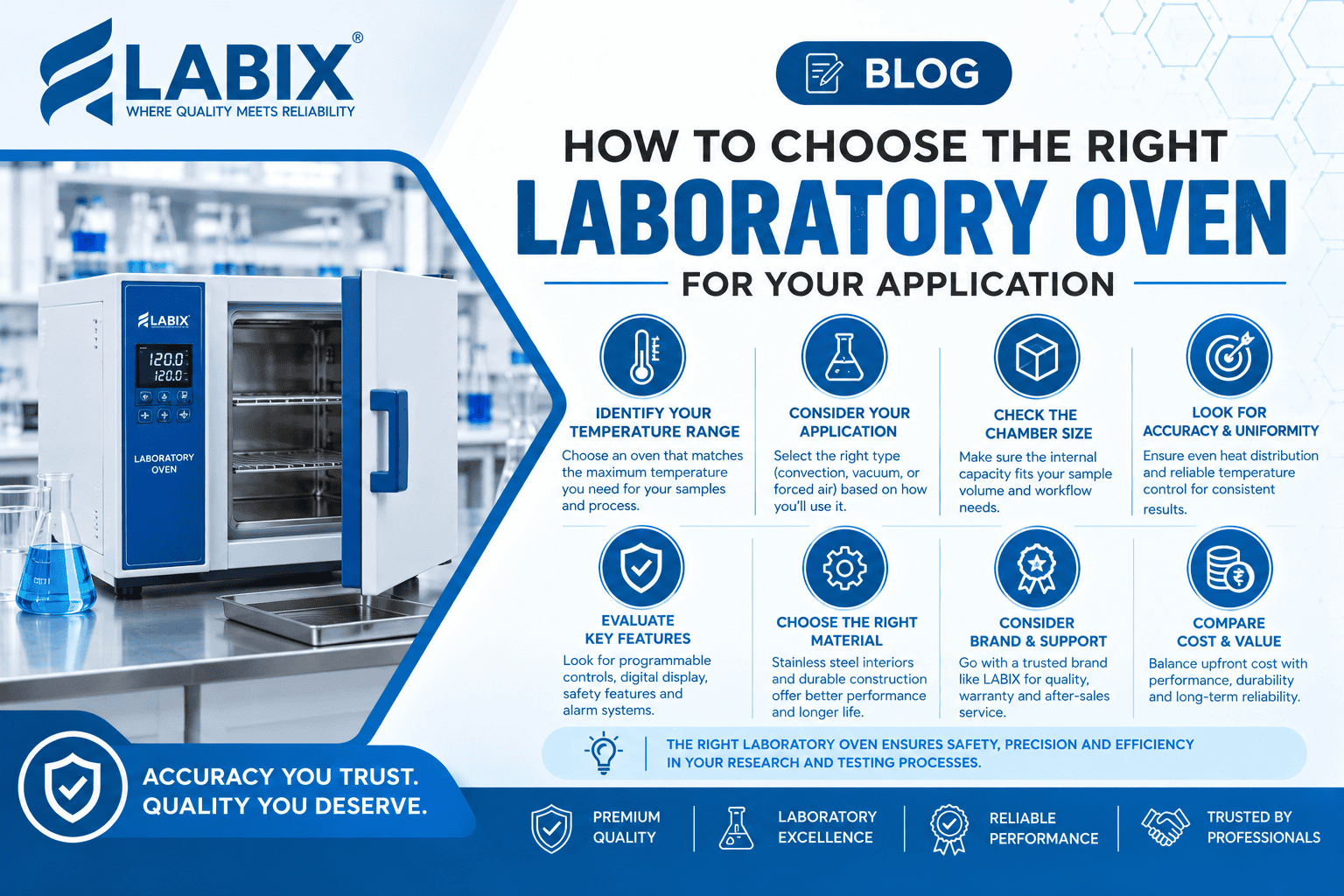
Choosing the right laboratory oven requires more than comparing prices or maximum temperatures. You need to consider your application, required temperature range, chamber capacity, airflow, temperature uniformity, and safety requirements. A suitable oven can support routine drying, moisture removal, sample preparation, and other controlled heating procedures.
Different laboratories have different needs. Research facilities may prioritize temperature stability, while educational institutions may focus on ease of operation and available space. Pharmaceutical and industrial laboratories may also require specific documentation and process controls.
This guide explains how to choose the right laboratory oven by comparing common oven types, evaluating important specifications, and matching equipment to your application. It also covers safety considerations and practical questions to ask before purchasing.
What Is a Laboratory Oven?
A laboratory oven is a temperature-controlled piece of equipment used to heat materials under defined conditions. Laboratories commonly use ovens for drying compatible glassware, removing moisture from suitable samples, conditioning materials, and performing other procedures that require controlled heating.
A typical laboratory oven contains an insulated chamber, heating elements, shelves, temperature sensors, and a temperature controller. Depending on the design, it may also include a fan, timer, alarm, or additional monitoring features.
Two important performance factors are temperature stability and temperature uniformity. Stability describes how consistently the oven maintains its temperature over time. Uniformity describes how consistently heat is distributed across different areas of the chamber.
Understanding these specifications helps laboratories choose equipment that meets their process requirements rather than relying only on the temperature displayed by the controller.
Types of Laboratory Ovens and Their Applications
Different laboratory oven designs support different heating requirements. Identify your process before selecting a particular type.
Hot Air Ovens
Hot air ovens provide controlled heating for applications such as drying compatible laboratory glassware, removing moisture, and heating suitable materials. They are commonly considered for routine work in research, educational, industrial, and quality-control laboratories.
When evaluating a hot air oven, check its temperature range, chamber dimensions, shelf arrangement, control system, and airflow configuration.
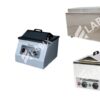
LABIX Industries lists a Hot Air Oven, Model LBX-101. Review the product page and current specifications to determine whether the model suits your intended procedure.
Forced-Air and Gravity-Convection Ovens
Forced-air ovens use a fan to circulate heated air through the chamber. Depending on the design and load, this circulation may improve heat distribution and help the oven recover its temperature after loading.
Gravity-convection ovens rely on natural air movement as heated air rises and cooler air descends. This design may suit applications where fan-driven airflow is undesirable.
Neither type is automatically the best choice for every process. Compare temperature uniformity, recovery time, sample characteristics, and manufacturer performance data before deciding.
Vacuum Ovens
Vacuum ovens heat materials under reduced pressure. They may suit certain heat-sensitive materials or processes that require reduced-pressure drying.
However, not every vacuum oven is suitable for every solvent or hazardous substance. Confirm the equipment’s compatibility, pressure limits, temperature limits, and safety provisions with the manufacturer before use.
High-Temperature Ovens
Some applications require temperatures beyond the range of a standard laboratory drying oven. Specialized high-temperature equipment or a furnace may be more appropriate for these processes.
Determine the actual process temperature and heating conditions before purchasing. Never assume that a conventional laboratory oven can safely perform treatments outside its rated operating range.
Key Factors to Consider When Choosing a Laboratory Oven
The right laboratory oven should meet your application’s technical requirements while fitting your available space, workload, and operating budget.
1. Temperature Range and Control
Start by identifying the temperature required for your procedure. Consider the normal working temperature, permitted variation, and highest temperature the process may require.
Compare these requirements with the oven’s rated temperature range. The maximum temperature alone does not tell you how accurately or uniformly the equipment maintains the required conditions.
Check these specifications:
- Minimum and maximum operating temperatures.
- Temperature stability over time.
- Temperature uniformity throughout the chamber.
- Controller type and sensor configuration.
- Calibration and verification requirements.
For example, a procedure that requires consistent heating throughout a sample load may need better temperature uniformity than a routine drying task. Confirm that the manufacturer’s performance data matches your operating requirements.
2. Chamber Capacity and Sample Load
Choose an oven with enough usable space for your normal workload. Consider the number of samples, their dimensions, container sizes, and the number of batches processed each day.
A small oven may restrict your workflow if you regularly process large batches. An unnecessarily large oven can occupy valuable laboratory space and may increase energy consumption.
Before purchasing, check:
- Internal chamber dimensions.
- Total chamber capacity.
- Number and arrangement of shelves.
- Clearance between shelves.
- Space needed around samples for air circulation.
Do not select an oven based only on its stated capacity in litres. The arrangement of your samples determines how much of that space you can use effectively.
3. Airflow and Temperature Uniformity
Airflow affects how heat moves around the chamber and reaches the samples. The suitable circulation method depends on the material being processed and the required heating conditions.
Forced-air circulation may help achieve more consistent heating for certain loads, while natural convection may be preferable when airflow could disturb lightweight samples.
Ask the manufacturer for temperature-uniformity data and the conditions under which it was measured. For process-critical work, consider whether performance needs verification with the intended sample load and shelf arrangement.
Do not confuse temperature uniformity with temperature accuracy. A controller can display the target temperature even when different parts of the chamber experience different temperatures.
4. Chamber Construction and Shelves
The chamber material should suit the intended application, cleaning requirements, and laboratory environment.
Review the inner chamber, external housing, insulation, door, and shelves. Stainless steel is used in many laboratory oven chambers, but the specific grade and construction should be confirmed from the product documentation.
Adjustable shelves can accommodate containers of different sizes. Check their load capacity and the space needed to maintain suitable airflow.
A practical shelf arrangement can make routine work easier without requiring a larger chamber.
5. Temperature Controls and Monitoring
The control system should provide the level of monitoring and process management required by your laboratory.
Basic applications may need straightforward temperature adjustment and display. More demanding procedures may benefit from programmable controllers, timers, alarms, or data-recording functions.
Before purchasing, confirm which features are standard and which are optional. Ask whether the system can support your documentation and traceability requirements.
For regulated or process-critical work, consult the relevant procedure and quality requirements to determine whether calibration records, temperature mapping, or formal equipment qualification are necessary.
6. Safety Features and Operating Requirements
Safety should be part of the selection process from the beginning. Consider over-temperature protection, alarms, electrical requirements, installation clearances, ventilation, and access for maintenance.
The suitability of an oven also depends on the materials being heated. Some samples can release vapours that create health, fire, or explosion hazards. A standard laboratory oven should not be used for flammable solvents or hazardous vapours unless the equipment is specifically designed and approved for that application.
Review the operating manual and relevant laboratory safety procedures before use. Follow manufacturer instructions and applicable workplace safety requirements.
How to Match a Laboratory Oven to Your Application
Different laboratory environments may prioritize different features. Define the intended procedure before comparing models.
Research and Testing Laboratories
Research laboratories may use ovens for sample drying, material conditioning, and controlled heating. Temperature stability, uniformity, repeatability, and documentation can be important when results depend on consistent processing conditions.
Check whether the research method specifies a temperature range, heating duration, or particular equipment performance requirement.
Pharmaceutical and Industrial Laboratories
Pharmaceutical and industrial applications may require defined operating procedures, traceable records, and evidence that equipment performs as intended.
Determine whether the process requires calibration, temperature mapping, equipment qualification, or other documented checks. These requirements depend on the application and applicable quality system.
Do not assume that a product meets a particular regulatory requirement unless the manufacturer provides supporting documentation.
Schools, Colleges, and Educational Laboratories
Educational laboratories may need an oven for supervised experiments, routine drying, and basic heating applications.
Consider the curriculum, expected workload, available space, ease of operation, and appropriate safety controls. A practical model that meets teaching requirements may be more suitable than equipment with advanced features the laboratory will not use.
Glassware Drying and Routine Laboratory Work
Laboratories that dry compatible glassware should consider chamber dimensions, shelf spacing, temperature requirements, and batch size.
Confirm that the glassware can tolerate the selected temperature and that the drying procedure is appropriate for the material. Drying is not automatically equivalent to sterilization or disinfection.
Laboratory Oven vs. Laboratory Incubator
A laboratory oven and an incubator serve different purposes, although both control temperature.
A laboratory oven is generally designed for heating, drying, moisture removal, and other specified thermal procedures. An incubator is generally designed to maintain controlled environmental conditions for biological cultures or other temperature-sensitive applications.
When comparing these devices, consider the intended sample, operating temperature, humidity requirements, airflow, monitoring features, and applicable procedure.
Do not select an oven simply because it reaches the required temperature. If your application requires incubation conditions, an oven may not provide the environmental controls you need.
Explore the LABIX Industries laboratory equipment range to review relevant equipment categories.
Common Mistakes to Avoid When Selecting a Laboratory Oven
Avoid these common purchasing mistakes:
- Choosing only by price: A low initial cost does not guarantee suitability for your application.
- Focusing only on maximum temperature: Temperature uniformity, stability, and control also matter.
- Ignoring chamber dimensions: A large capacity rating does not guarantee that your samples will fit properly.
- Overlooking airflow: Poor sample placement or blocked airflow can affect heating performance.
- Assuming all ovens provide sterilization: Confirm the equipment and procedure requirements before making this claim.
- Ignoring hazardous vapours: Never assume a standard oven is suitable for flammable or hazardous materials.
- Skipping specification checks: Confirm model-specific features, power requirements, documentation, warranty, and service arrangements before ordering.
A clear list of requirements helps you compare products consistently and reduces the risk of choosing unsuitable equipment.
Laboratory Oven Selection Checklist for Buyers
Use this checklist when reviewing laboratory oven options or requesting quotations:
- Identify the intended application and sample type.
- Confirm the required temperature range.
- Define acceptable temperature stability and uniformity.
- Calculate the required usable chamber capacity.
- Check shelf arrangement and sample clearance.
- Select the appropriate airflow method.
- Review controller, timer, alarm, and monitoring features.
- Confirm electrical supply and installation requirements.
- Check safety provisions and material compatibility.
- Determine calibration, documentation, or qualification needs.
- Review cleaning, maintenance, warranty, and after-sales support.
- Compare the total cost of ownership, not only the purchase price.
Share these requirements with suppliers so they can recommend equipment based on your actual application.
Frequently Asked Questions
What temperature range should I look for in a laboratory oven?
Choose a temperature range that covers your procedure’s normal operating conditions and required limits. Check the manufacturer’s stated accuracy, stability, and uniformity at the temperatures you plan to use.
What is the difference between a laboratory oven and a drying oven?
The terms can overlap. Both may describe equipment used for controlled drying and heating. Compare the intended application, temperature range, airflow, and performance specifications rather than relying on the product name alone.
Is a forced-air laboratory oven better than a gravity-convection oven?
Not always. Forced-air ovens actively circulate air, while gravity-convection ovens rely on natural movement. The suitable option depends on sample characteristics, heating requirements, and the required temperature distribution.
How do I choose the right laboratory oven capacity?
Consider sample dimensions, batch size, shelf spacing, airflow clearance, and expected workload. Select an oven that accommodates your normal load without overcrowding the chamber.
Can a laboratory oven be used for sterilization?
Only when the equipment and procedure are suitable for the intended sterilization process. A drying oven should not automatically be treated as a validated sterilization system. Follow the relevant procedure and manufacturer documentation.
What safety features should a laboratory oven have?
Depending on the application, useful provisions may include over-temperature protection, alarms, suitable electrical protection, and clear operating instructions. Confirm the requirements for your materials, environment, and local safety procedures.
Conclusion
Choosing the right laboratory oven starts with understanding your application. Compare the required temperature range, chamber capacity, airflow, temperature uniformity, controls, and safety provisions before making a decision. Also consider maintenance, documentation, and the long-term cost of operating the equipment.
Review the manufacturer’s specifications carefully and confirm that the selected model meets your process requirements. Explore the LABIX Industries Hot Air Oven to review its listed features and available capacities. Contact the supplier for current specifications and application-related guidance before placing an order.



Add comment