
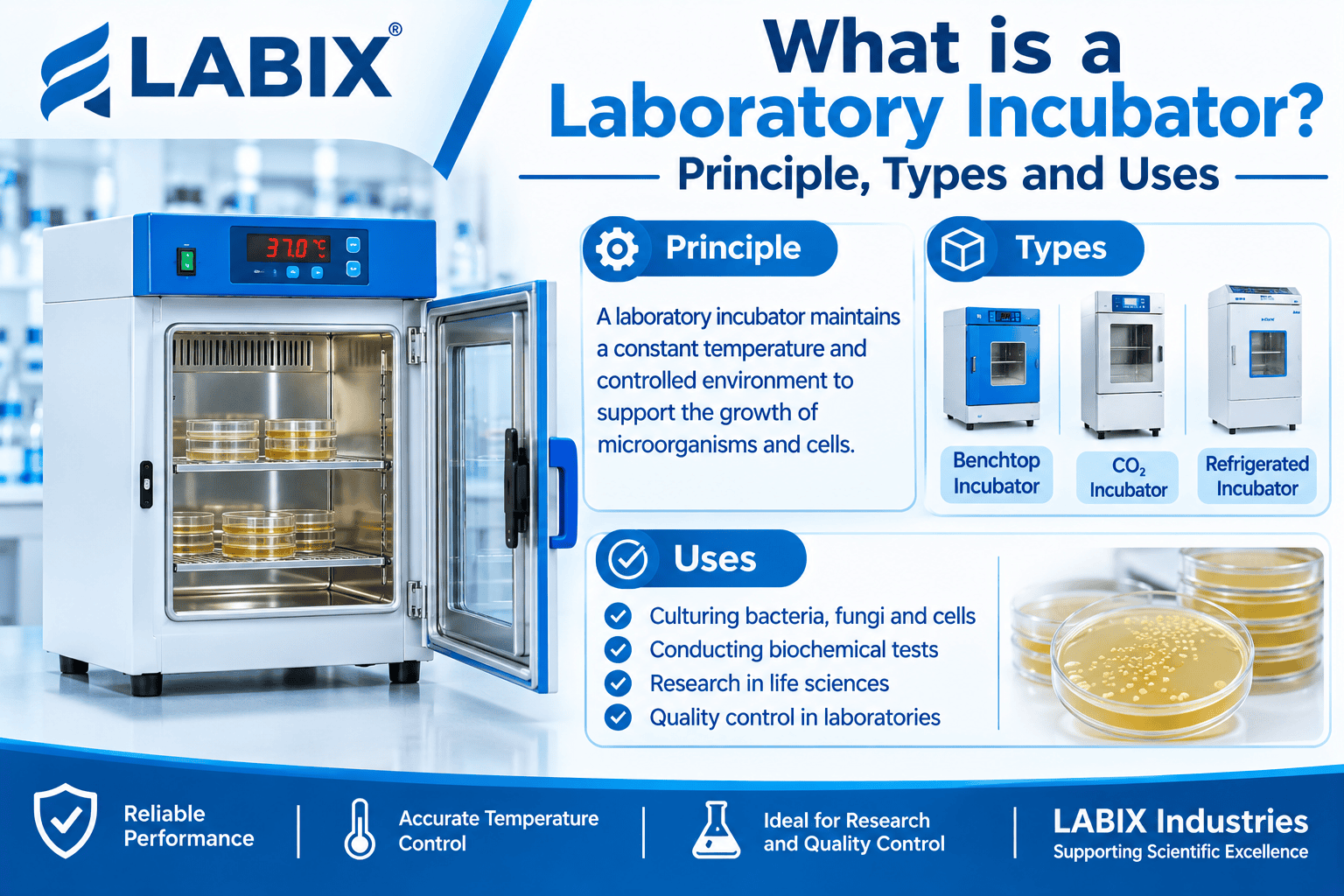
A laboratory incubator is a temperature-controlled chamber that gives biological samples a stable, protected environment for growth, reaction or storage. Laboratories use a laboratory incubator to culture bacteria, grow cells, run biological oxygen demand tests and hold samples at a fixed temperature for hours or days. LABIX Industries presents itself as a manufacturer and supplier of laboratory equipment, and its incubator range includes bacteriological, B.O.D. and CO₂ models for research, clinical and pharmaceutical work. This guide explains how an incubator works, which models exist and how to choose one.
You will also see the practical uses of a laboratory incubator, the specifications worth comparing, and the questions to ask a laboratory incubator manufacturer in India before you place an order.
What Is a Laboratory Incubator?
An incubator holds a sample at conditions that favour a biological or chemical process. The most important condition is temperature, but many models also control carbon dioxide, humidity, light or motion.
Most microbiology work depends on that stability. Many bacteria that affect human health grow well near body temperature, around 37°C, while other organisms and tests need cooler or warmer settings. An incubator keeps the chamber at the chosen value so that results stay repeatable from one day to the next.
You will find incubators in hospital and diagnostic laboratories, pharmaceutical quality control, food and water testing, university research and school science departments.
Laboratory Incubator Principle: How It Works
The laboratory incubator principle is controlled heating with feedback. A sensor measures the chamber temperature, a controller compares it with the set value, and the heater switches on or off to close the gap. Good insulation and even air distribution keep the temperature uniform from shelf to shelf.
The main components work together as follows:
- Heating element: Supplies the heat. Some designs place elements on several sides of the chamber for more even warming.
- Temperature sensor: Reads the chamber temperature. PT-100 resistance sensors are common in laboratory equipment.
- Controller: Usually a digital PID controller that adjusts power smoothly instead of switching it fully on and off.
- Double-wall chamber and insulation: An inner chamber, an outer shell and an insulating layer between them reduce heat loss.
- Air circulation: Natural convection relies on rising warm air, while a fan improves uniformity and recovery time after the door opens.
- Alarms and timers: Warn the user about over-temperature conditions and run timed experiments.
Cooled models add refrigeration so the chamber can hold temperatures below room level, and CO₂ models add a gas sensor and valve circuit.
People often confuse incubators with ovens, since both use heat. An oven is built to dry or heat-treat materials at higher temperatures, while an incubator is built to hold a gentle, stable temperature for living samples. If you are comparing the two, the LABIX guide on how to choose the right laboratory oven for your application explains the oven side of that decision.
Types of Laboratory Incubator
The types of laboratory incubator differ mainly in temperature range, gas control and motion. The table gives a quick comparison before the detail.
| Type | Key feature | Typical use |
| Bacteriological (general-purpose) | Stable heating, mostly above room temperature | Routine microbial culture |
| B.O.D. | Cooled chamber with low-temperature stability | Biological oxygen demand tests, culture storage |
| CO₂ | Controlled CO₂, humidity and temperature | Cell and tissue culture |
| Shaking | Heating plus orbital motion | Liquid cultures that need agitation |
| Dry bath | Heated block for tubes | Small-volume sample incubation |
Bacteriological Incubator
A bacteriological incubator is the general-purpose workhorse for growing bacteria, fungi and other microorganisms. The bacteriological incubator from LABIX Industries is listed as Model LBX-105 with a double-wall build, a polished grade 304 stainless steel inner chamber and a PT-100 sensor. The product page gives a temperature range of ambient +5°C to 110°C with ±1°C accuracy and capacities from 28 to 720 litres. Optional extras include an air circulating fan and a microprocessor PID controller with timer and alarm. Check the exact range and options against your protocol before ordering.
B.O.D. Incubator
B.O.D. stands for biological oxygen demand. In the standard BOD test, water samples are held at 20°C for five days so that analysts can measure how much oxygen microorganisms consume. That job needs a chamber that holds a steady low temperature, which is why environmental and water-testing laboratories use cooled incubators. The B.O.D. incubator listed by LABIX Industries (Model LBX-106) shows a temperature range of +5°C to 50°C with ±1°C accuracy, two air circulation fans and capacities from 112 to 420 litres.
CO₂ Incubator
Mammalian cell cultures typically need about 37°C, high humidity and a controlled share of carbon dioxide, often around 5%, to keep the culture medium at the right pH. A CO₂ incubator regulates all three. The CO₂ incubator on the LABIX website (Model LBX-108) lists an infrared sensor with a 0–20% CO₂ range, temperature uniformity of 0.2°C at 37°C, audible and visual alarms, a USB port for data and capacities from 50 to 160 litres, with air-jacket and water-jacket versions.
Other Incubator Types
Shaking incubators combine heat with orbital motion for liquid cultures, and dry bath incubators heat tubes in a metal block. LABIX Industries lists both an orbital shaking incubator and a digital dry bath incubator in its incubator category.
Uses of Laboratory Incubator Models Across Industries
The uses of laboratory incubator equipment extend well beyond a microbiology bench. Common applications include:
- Clinical and diagnostic laboratories: Culturing patient samples to identify microorganisms.
- Pharmaceutical laboratories: Microbial testing and culture work that supports quality control.
- Water and environmental testing: BOD testing and other microbial analysis of water samples.
- Food and beverage testing: Checking products for microbial growth under controlled conditions.
- Biotechnology and research: Growing cell lines, enzyme reactions and other temperature-sensitive experiments.
- Education: Teaching practical microbiology in colleges and universities.
The right model depends on the organism, the protocol and the required temperature, so match the incubator to the method rather than to the industry label alone.
How to Choose the Right Laboratory Incubator
A suitable laboratory incubator is the one that fits your protocol, workload and compliance needs. Work through these points before you request a quotation:
- Temperature range and uniformity: Confirm that the range covers your setpoints, with a margin, and ask how uniformity is specified.
- Capacity and shelving: Estimate how many plates, flasks or racks you will load at peak, and add room for air to circulate.
- Chamber material: Stainless steel interiors are easier to clean and resist corrosion.
- Controller and alarms: A digital PID controller with an over-temperature alarm adds reliability. If you need audit-ready records, ask about data logging and software options.
- Gas and humidity control: Only cell culture work normally needs a CO₂ incubator.
- Power supply: The LABIX incubator pages list 230±10V/50Hz, so confirm voltage compatibility for your country.
- Calibration and maintenance: Ask how the unit is calibrated, how to verify it and what spare parts exist.
- Budget over the full lifecycle: Compare running cost, service support and warranty, not only the purchase price.
LABIX Industries publishes model numbers, chamber sizes, capacities and optional features on its incubator product pages, which helps procurement teams compare options against their own checklist before contacting the sales team.
What to Ask a Laboratory Incubator Manufacturer in India
When you shortlist a laboratory incubator manufacturer in India, request the following in writing: the full technical specification, the list of standard and optional features, installation and training support, calibration guidance, the warranty terms and the after-sales contact process. If your laboratory works under a quality system, ask for the relevant certificates and check that their scope matches the equipment you are buying. Customised sizes and controllers are sometimes possible, so state your requirements early.
Installation, Use and Maintenance Tips
- Place the incubator on a level surface with space around it for ventilation.
- Allow the chamber to stabilise at the setpoint before loading samples.
- Avoid overloading shelves, because crowded loads block air flow.
- Open the door as little as possible to protect temperature stability.
- Verify the displayed temperature with a calibrated reference thermometer at regular intervals.
- Clean the chamber with a disinfectant that suits the interior material.
- Never place flammable or volatile solvents inside a general-purpose incubator.
Follow the manufacturer’s manual for your model, since cleaning agents, calibration steps and safety limits differ between designs.
Frequently Asked Questions
What is the difference between a bacteriological incubator and a CO₂ incubator?
A bacteriological incubator controls temperature for routine microbial culture. A CO₂ incubator also controls carbon dioxide and humidity, which cell and tissue cultures need.
What temperature is used in a laboratory incubator?
It depends on the organism and method. Many bacterial cultures run near 37°C, while BOD testing uses 20°C. Always follow your validated protocol.
How often should an incubator be calibrated?
There is no single schedule. Laboratories set intervals under their quality system and the manufacturer’s guidance, and they check the temperature against a calibrated reference regularly.
Can I use a laboratory oven instead of an incubator?
Usually not. Ovens are designed for drying and heat treatment at higher temperatures, and they do not give the gentle, uniform control that living samples need.
What capacity should I choose?
Estimate your peak load and add space for air circulation. Manufacturer pages often list several capacities, so compare the chamber dimensions with your racks or plates.
Conclusion
A laboratory incubator works by measuring the chamber temperature and holding it steady with a controlled heater, good insulation and even air flow. Choosing the right type, whether bacteriological, B.O.D. or CO₂, depends on your organism, protocol and workload. Compare temperature range, capacity, controls and support before you buy. LABIX Industries lists model-wise specifications for its incubators, so review the product pages, compare them with your requirements and contact the team to discuss a suitable model.

Add comment