
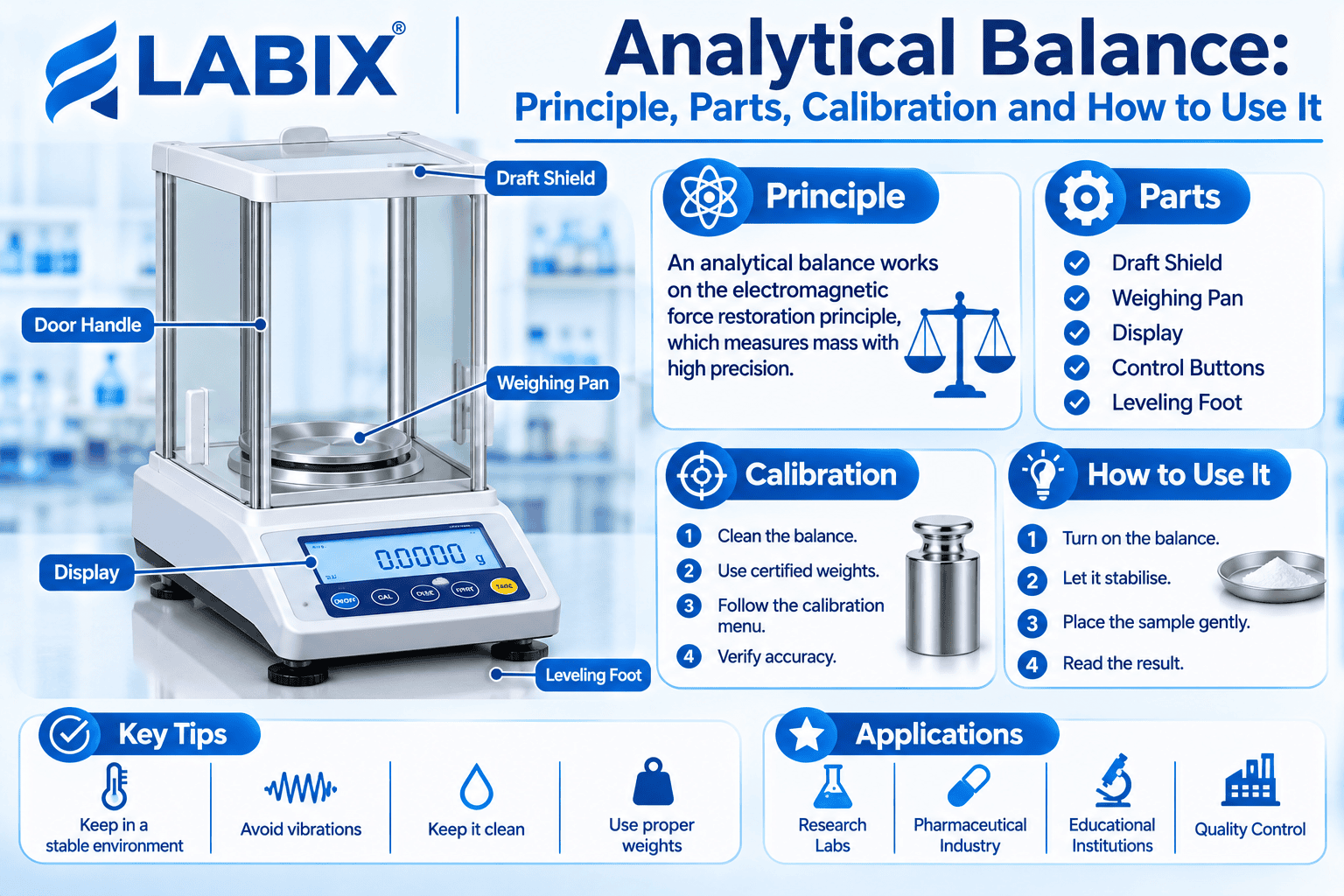
The analytical balance principle is electromagnetic force restoration: the instrument measures the current needed to hold the weighing pan in position and converts it into a mass reading, typically to 0.1 mg or finer. Understanding this principle, along with the balance’s parts and calibration needs, helps laboratories prevent weighing errors that carry into every later result. LABIX Industries, a laboratory equipment manufacturer and supplier in India, offers weighing-based instruments such as digital moisture balances alongside analytical, pharmaceutical and educational laboratory equipment.
This guide explains how the instrument works, what each part does, how calibration is performed, how to weigh correctly and where it is used. It is written for students, technicians, quality-control analysts and buyers who need practical, technically sound information.
What Is an Analytical Balance?
An analytical balance is a laboratory weighing instrument that measures small masses with a readability of 0.1 mg (0.0001 g) or finer. Typical capacities run from tens of grams to a few hundred grams, which suits sample preparation, standard solutions and formulation work rather than bulk weighing.
What sets it apart from an ordinary precision balance is the enclosed weighing chamber. At this sensitivity, air currents, vibration and even the warmth of a hand can shift the reading. Note also that readability is not accuracy: readability is the smallest increment on the display, while accuracy depends on calibration, repeatability, linearity and the weighing environment. For a wider overview of the tools around the balance, see this guide to laboratory equipment and their uses.
Analytical Balance Principle: How the Instrument Measures Mass
Analytical balances generally rely on electromagnetic force restoration (EMFR). When a sample is placed on the pan, the weighing system moves down slightly. A position sensor detects this movement, and a control circuit sends current through a coil located in the field of a permanent magnet. The resulting electromagnetic force pushes the system back to its original position. The current needed for this restoration is proportional to the load, so the electronics convert it into mass and show it on the display. Strain-gauge load cells are more common in lower-resolution instruments.
Why the Principle Matters in Daily Work
Because the balance responds to force, it is sensitive to gravity, buoyancy and anything else that pushes or pulls on the pan. Local gravity varies slightly with latitude and altitude, so a balance should be calibrated where it is used and again after it is moved. Static charge on plastic weighing boats or dry powders can also attract or repel the pan and cause drifting readings. Knowing the principle makes these symptoms easier to diagnose.
Analytical Balance Parts and Their Functions
Layouts differ between manufacturers, but most models share the following analytical balance parts.
Weighing Pan and Draft Shield
The pan holds the sample container and is usually small and made of stainless steel. The draft shield, also called the weighing chamber or windscreen, is a glass enclosure with sliding doors that blocks air movement. Keep the doors closed while reading the display.
Weighing Cell
The weighing cell houses the position sensor, coil, magnet and the mechanical system that carries the pan load. It is the most delicate component, so avoid overloading the pan or dropping samples onto it.
Display and Control Keys
The display shows mass, unit and a stability indicator. Keys or a touchscreen handle taring, unit conversion, calibration and settings, and many models include a data port for recording results.
Leveling Feet and Level Indicator
Adjustable feet and a bubble level let you set the balance horizontally. An unlevel balance gives poor repeatability, so check the bubble before calibration and whenever the instrument is moved.
Analytical Balance Calibration
Analytical balance calibration adjusts the instrument so that displayed values agree with a known reference mass. It differs from a routine check: calibration adjusts the balance, while a routine check verifies that it still performs within the tolerance your quality system defines.
Internal and External Calibration
Internal calibration uses a reference weight built into the balance and applied automatically, often at set intervals or after a temperature change. External calibration uses certified weights that you place on the pan yourself. Always check which method your model uses and follow the manufacturer’s manual.
Step-by-Step Calibration Procedure
1. Place the balance on a stable bench, away from drafts, air-conditioning vents and direct sunlight.
2. Level the balance using the feet and confirm the bubble is centered.
3. Switch it on and allow the warm-up time stated in the manual.
4. Clean the pan and make sure the chamber is empty.
5. Start calibration from the menu.
6. When prompted, place the certified calibration weight on the pan using forceps or gloves, then close the doors.
7. Wait for the confirmation, remove the weight, and verify with a second check weight.
8. Record the result in the balance logbook.
Use weights of the class specified in the balance manual, and never handle them with bare fingers.
How Often to Calibrate
No single interval suits every laboratory. Calibrate after installation, relocation or leveling changes, after a significant temperature change, and according to your quality procedures. Regulated laboratories often combine routine performance checks with periodic calibration by a qualified service provider.
How to Use an Analytical Balance Step by Step
Learning how to use analytical balance equipment properly matters as much as the instrument’s specification. Follow this routine for most solid samples.
1. Confirm the balance is level, clean and reads zero with an empty pan.
2. Let the sample reach room temperature, since warm samples create convection currents that distort readings.
3. Place the weighing vessel on the pan with gloves or forceps, close the doors and press tare.
4. Add the sample gradually with a spatula, closing the doors before each reading.
5. Record the mass once the stability indicator appears.
6. Remove the vessel, confirm the display returns to zero and clean any spills with a soft brush.
For hygroscopic or volatile samples, use weighing by difference: weigh the capped container before and after transferring the sample, and calculate the mass from the two readings.
Common Errors to Avoid
• Weighing near drafts, vibration or heat sources.
• Placing warm or cold samples directly on the pan.
• Touching vessels or weights with bare hands.
• Ignoring static charge on plastic containers.
• Overloading the pan beyond its stated capacity.
Analytical Balance Uses in Laboratories and Industry
Analytical balance uses cover any task where small mass differences affect results.
Pharmaceutical and Quality Control Work
Laboratories weigh reference standards and samples to prepare standard and sample solutions. In HPLC analysis, for example, every calibration point depends on accurately weighed standards. LABIX Industries supplies an HPLC system for laboratories running such chromatographic work, so the balance and the instrument can be planned together.
Research and Education
Researchers weigh reagents and buffer components, while students use balances for titrations and gravimetric exercises. Reliable weighing is the first step in any quantitative experiment.
Moisture and Gravimetric Testing
Gravimetric methods such as loss on drying compare sample mass before and after heating. Moisture balances automate this by combining a weighing system with a heat source. The Digital Moisture Balance (LBX-646) from LABIX Industries lists a 50 g weighing range, 1 mg readability and a halogen lamp heat source. Since 1 mg is coarser than the 0.1 mg of a typical analytical balance, a moisture balance complements an analytical balance rather than replacing it.
How to Choose an Analytical Balance
Match the instrument to the task using these criteria: required readability and capacity, repeatability and linearity, internal or external calibration, bench conditions and available space, data output for documentation, and the supplier’s service support and datasheet. Confirm every specification in the manufacturer’s documentation rather than relying on general descriptions.
Buyers comparing weighing-based instruments can also review the Digital Moisture Balance (Touch Screen), model LBX-645. Its listed specifications include 100 g capacity, 0.001 g readability, external calibration, a touchscreen and storage for 8 records. For fine analytical weighing, check the required readability against the datasheet before ordering.
Frequently Asked Questions
What is the principle of an analytical balance?
It measures the electromagnetic force needed to keep the weighing pan in its reference position and converts the required current into a mass value.
How does an analytical balance differ from a precision balance?
An analytical balance reads to 0.1 mg or finer and uses an enclosed draft shield. Precision balances usually read to 1 mg or coarser and are often open to the air.
Why does an analytical balance need a draft shield?
Even gentle air movement exerts force on the pan at this sensitivity. The shield keeps readings stable and repeatable.
Can an analytical balance be used on any bench?
No. It needs a level, vibration-free surface away from drafts, direct sunlight and heat sources, and ideally a stable room temperature.
What should I do if the reading keeps drifting?
Check the level, close the doors, let the sample reach room temperature and look for static or moisture uptake. If drift continues, recalibrate and consult the manual or service provider.
Conclusion
The analytical balance principle, electromagnetic force restoration, explains why placement, leveling, calibration and technique matter so much. By understanding the main parts, calibrating and checking regularly, and following a disciplined weighing routine, laboratories improve the reliability of every result that follows. Before buying or replacing a balance, compare readability, capacity, calibration method and working conditions against the manufacturer’s documentation. LABIX Industries supplies laboratory and scientific equipment for research, pharmaceutical and educational users. To discuss requirements or request









Add comment