
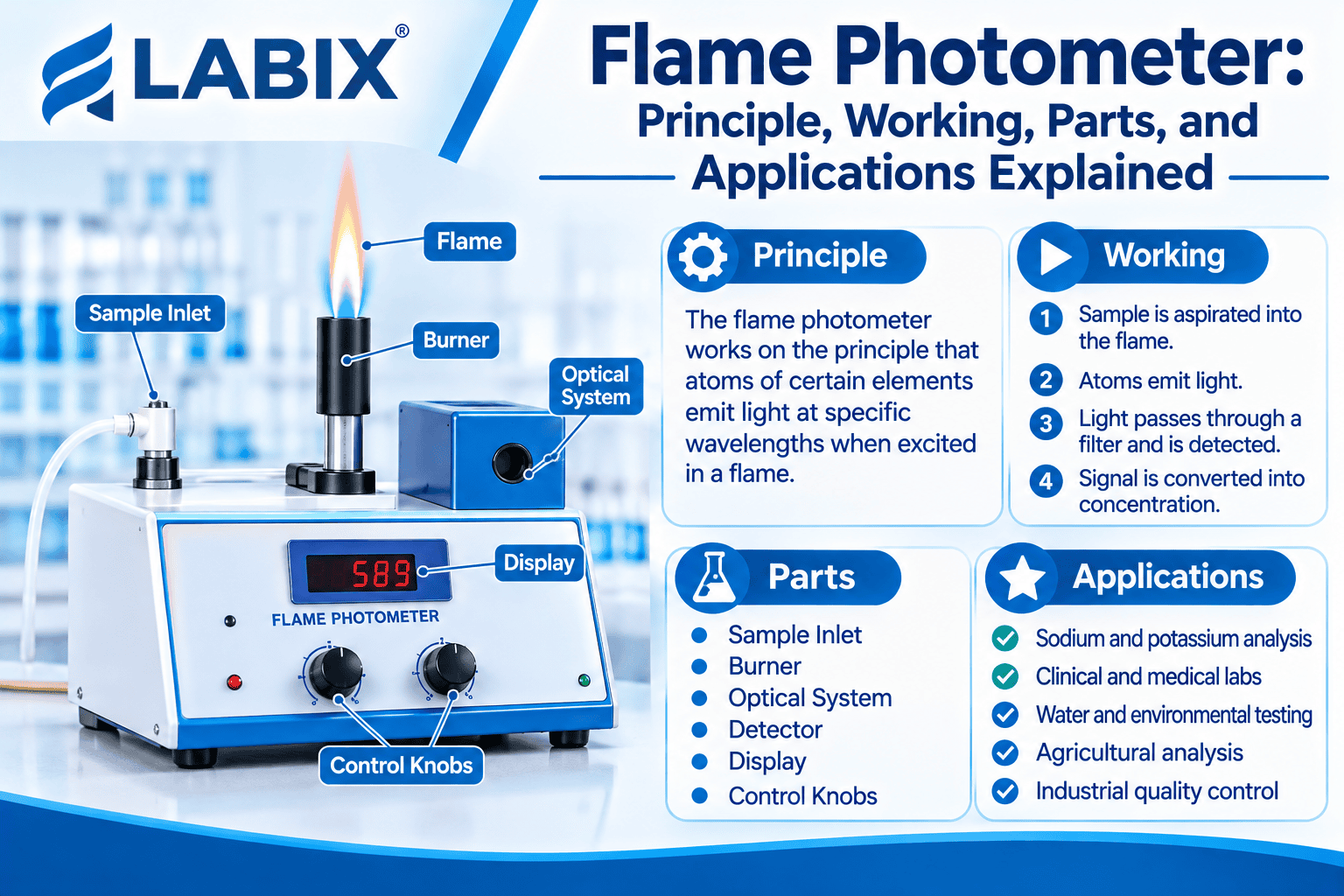
Anyone comparing instruments for sodium, potassium, or lithium estimation eventually asks the same question: what is the flame photometer principle? In simple terms, the instrument burns a liquid sample in a controlled flame. An optical filter isolates the metal ion’s characteristic emission colour, and a photodetector converts that light intensity into a readable concentration. LABIX Industries is a laboratory and pharmaceutical equipment manufacturer. It offers microprocessor-based flame photometers for clinical, pharmaceutical, and research laboratories that routinely test alkali and alkaline earth metals. Understanding how the instrument works makes it easier to use it correctly. It also helps you choose a model suited to your lab’s testing volume and accuracy needs.
What Is a Flame Photometer?
A flame photometer is an analytical instrument used to measure metal ion concentrations. It mainly detects sodium (Na), potassium (K), lithium (Li), calcium (Ca), and barium (Ba) in liquid samples. It works on the principle of flame photometry, a branch of atomic emission spectroscopy. The instrument introduces the sample into a flame. Excited metal atoms then emit light, which the instrument measures.
Many laboratories consider flame photometry simpler and more economical than techniques like atomic absorption spectroscopy or inductively coupled plasma analysis. This explains why clinical biochemistry, pharmaceutical quality control, soil and water testing, and teaching laboratories continue to rely on it for routine alkali-metal estimation without the cost of more complex instrumentation.
Flame Photometer Principle
The flame photometer works on the principle of a controlled flame test. When a metal salt solution enters the flame, heat excites the outer electrons of its atoms. These electrons move to a higher energy level. As they return to their original (ground) state, they release energy as light. Each element emits light at a specific wavelength and produces a characteristic flame colour. For example, sodium produces a yellow-orange flame, potassium produces a violet flame, and calcium produces a brick-red flame.
How Flame Photometry Detects Metal Ions
An optical filter selects the wavelength of the element being measured. It blocks interference from other elements in the sample. A photodetector measures the intensity of the filtered light. This intensity is proportional to the metal ion concentration. The instrument compares this reading with a calibration curve. The curve uses standard solutions of known concentrations. It then calculates and displays the sample concentration, usually in ppm or meq/L.
This same underlying logic applies across most routine analytical techniques: calibration converts a measurable physical signal into a concentration value. LABIX Industries’ guide on what is HPLC: principle, components, working and applications discusses this same concept, explaining how a different analytical method separates and quantifies compounds in a sample.
Flame Photometer Working Process
Understanding flame photometer working in practical, step-by-step terms helps explain why consistent sample handling and flame stability matter so much to result accuracy:
- Sample aspiration: The liquid sample is drawn into the instrument through a capillary tube, usually with the help of compressed air or an in-built air compressor.
- Nebulization: A nebulizer converts the liquid sample into a fine mist (aerosol), which ensures uniform and efficient introduction into the flame.
- Flame formation: The nebulized sample mixes with fuel gas, commonly LPG, and dry oil-free air to form a stable flame at a controlled temperature.
- Excitation and emission: Metal atoms in the sample absorb thermal energy from the flame, become excited, and emit light as they return to a lower energy state.
- Filtration: An optical filter selects the wavelength specific to the element being tested, for example, separate filters for sodium and potassium.
- Detection: A photodetector, often a silicon photodiode, measures the intensity of the filtered light.
- Readout: The signal is processed, and the concentration is displayed digitally, often alongside features like auto flame-failure detection for safer operation.
Operators generally calibrate the instrument against standard solutions of known concentration before running samples, since calibration accuracy directly affects the reliability of every subsequent reading.
Key Parts of a Flame Photometer
A clear picture of flame photometer parts makes it easier to understand both operation and maintenance requirements:
- Burner assembly: Produces and sustains the flame used to excite sample atoms.
- Nebulizer: Converts the liquid sample into a fine aerosol mist for consistent flame introduction.
- Fuel and air supply system: Supplies LPG and oil-free, moisture-free compressed air to maintain a stable flame; many models include a built-in air compressor.
- Optical filters: Isolate the emission wavelength of the target element, commonly supplied for sodium and potassium as standard, with additional filters available for other elements.
- Photodetector: Measures the intensity of filtered light; silicon photodiodes are a common choice for sensitivity and stability.
- Display and control unit: Shows digital readouts of concentration values and allows calibration and parameter adjustments; many current instruments use graphical LCD or touch-based displays.
- Flame failure protection: A safety feature that automatically detects flame extinguishing and shuts off gas flow to prevent hazards.
LABIX Industries’ microprocessor flame photometer is built around this same configuration, combining a microprocessor-based control system with a nebulizer, LPG-and-air flame system, and digital readout for alkali and alkaline earth metal analysis in laboratory settings.
Flame Photometer Applications
Flame photometer applications span several industries where rapid, routine alkali-metal estimation is required rather than ultra-trace detection:
- Clinical and diagnostic laboratories: Estimating sodium and potassium levels in serum, urine, and other biological fluids to support diagnostic and electrolyte-balance assessments.
- Pharmaceutical quality control: Testing raw materials and formulations for sodium, potassium, calcium, and related elements as part of quality assurance protocols.
- Agricultural and soil testing: Measuring potassium and sodium content in soil extracts to guide fertilizer recommendations.
- Food and beverage testing: Checking sodium and potassium levels in food products and processed beverages.
- Water and environmental testing: Assessing alkali metal content in water samples as part of broader water-quality evaluation.
- Educational and research laboratories: Teaching the fundamentals of atomic emission spectroscopy through a relatively simple and accessible instrument.
For labs handling higher sample throughput or needing dual-element analysis, models such as LABIX Industries’ microprocessor flame photometer with dual LED display are designed to support simultaneous measurement workflows commonly needed in busy clinical or pharmaceutical settings.
How to Choose the Right Flame Photometer
Selecting a suitable instrument depends on matching its specifications to your actual testing needs rather than choosing based on price alone. Consider the following factors:
- Elements to be tested: Confirm whether the instrument supports the specific elements your lab routinely analyzes, such as Na, K, Li, Ca, or Ba, and whether the required filters are included.
- Measurement range and accuracy: Check the ppm or meq/L range and stated accuracy against your application’s requirements, whether clinical, pharmaceutical, or agricultural.
- Sample throughput: Labs running high volumes may benefit from dual-channel or simultaneous-measurement models to reduce turnaround time.
- Calibration and maintenance: Understand the calibration frequency needed and the availability of consumables like nebulizer tips and filters.
- Safety features: Flame-failure auto-detection is an important safety consideration for any combustion-based instrument.
- Operating environment: Confirm compatibility with available fuel supply (typically LPG) and compressed, oil-free air.
LABIX Industries supplies flame photometers for various laboratory and pharmaceutical applications. Its range includes the Microprocessor Flame Photometer Model LBX-624/625. This model is designed for clinical, industrial, agricultural, and research applications. Before purchasing, review the instrument’s specifications. Check whether they match your laboratory’s sample types and testing frequency. This helps ensure the right instrument for your requirements.
Maintenance and Safety Considerations
Routine maintenance directly affects flame photometer accuracy and service life. Regular maintenance helps ensure accurate and reliable results. Clean the nebulizer and burner assembly to prevent blockages. Check fuel and air lines regularly for leaks. Recalibrate the instrument using fresh standard solutions. Replace worn filters and seals when needed.
The instrument uses an open flame and pressurized gas. Therefore, operators must follow laboratory gas-handling safety practices. Ensure proper ventilation in the testing area.
Frequently Asked Questions
What is the basic principle behind a flame photometer?
A flame photometer works on the principle of flame emission spectroscopy. A sample is burned in a flame, metal atoms get excited, and the light they emit on returning to a lower energy state is measured to determine concentration.
Which elements can a flame photometer typically measure?
Most flame photometers are designed to measure alkali and alkaline earth metals. These include sodium, potassium, lithium, calcium, and barium. These elements produce easily detectable light emissions. They also require relatively low energy for excitation in a flame.
What type of flame does flame photometry use?
Flame photometers commonly use an LPG-and-air flame, maintained at a controlled, stable intensity to ensure consistent sample excitation and reliable readings.
How is a flame photometer different from a spectrophotometer?
A flame photometer measures light emitted by excited atoms in a flame, while a spectrophotometer typically measures light absorbed or transmitted through a sample at specific wavelengths. Both are optical analytical techniques, but they rely on different physical phenomena.
Why is calibration important before using a flame photometer?
Calibration against known standard solutions establishes the relationship between emission intensity and concentration. Without proper calibration, readings may not accurately reflect the actual metal ion concentration in the sample.
Conclusion
The flame photometer principle rests on a straightforward idea: burn a sample, isolate the characteristic light its metal ions emit, and convert that signal into a concentration reading. Understanding the working process, core parts, and real-world applications helps laboratories use the instrument correctly and select a model matched to their testing volume and accuracy requirements. LABIX Industries supplies microprocessor-based flame photometers designed for clinical, pharmaceutical, and research laboratory use. Before purchasing, it is worth reviewing the detailed specifications of available models and comparing them against your lab’s specific element-testing needs and sample throughput to ensure the right fit.

Add comment