
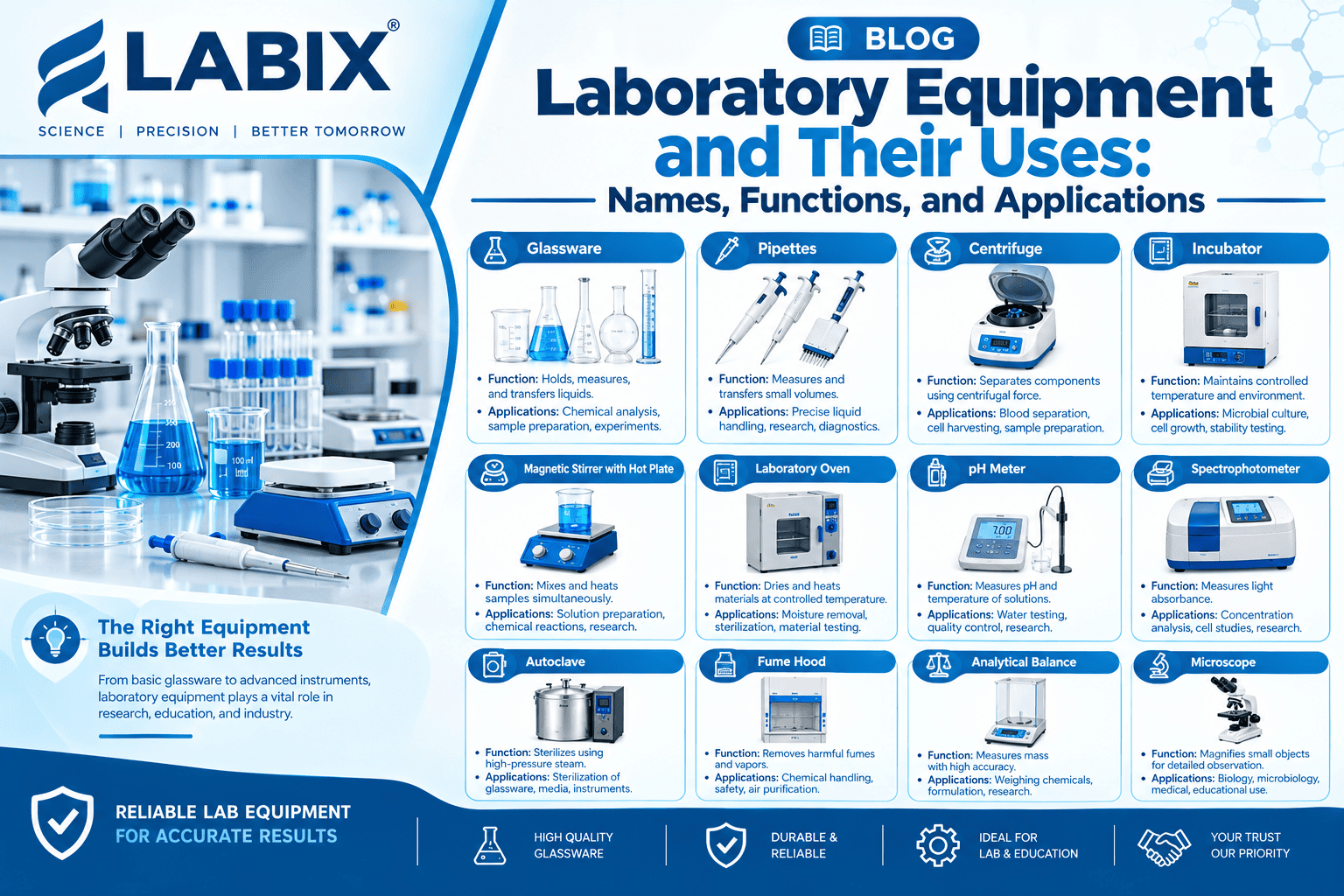
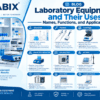
Laboratory equipment and their uses are easiest to understand when the tools are grouped by function: measuring, heating, mixing, separating, sterilizing and analyzing. Basic apparatus such as beakers and burettes hold or measure samples, while instruments such as a pH meter, centrifuge, or spectrophotometer measure or separate the properties of a sample. Choosing the right tool affects accuracy, safety, and repeatability in school, pharmaceutical, healthcare, and research laboratories. This guide explains common laboratory equipment names and uses, covers water testing laboratory equipment, and shows how to choose, handle, and calibrate instruments.
What Is Laboratory Equipment?
Laboratory equipment is the set of tools, instruments, and consumables used to prepare, handle, measure, and analyze samples in a controlled setting. It is usually divided into three groups. Laboratory apparatus, such as beakers, flasks, and stands, holds or supports samples. Laboratory instruments, such as a pH meter or centrifuge, measure or process a sample. Consumables, such as filter paper, stoppers, and cuvettes, are replaced regularly.
The right mix depends on the field. A school chemistry lab relies mainly on basic glassware, while a pharmaceutical quality control lab adds analytical instruments and documented calibration.
Equipment quality and correct use matter because every result depends on the tools behind it. A worn pipette, an uncalibrated meter, or an unsuitable container can introduce errors that are hard to trace later. Labs therefore keep equipment lists, calibration records, and operating procedures so that results can be repeated by another person on another day. For buyers, this means looking beyond the name of an item to its range, accuracy, materials, and documentation.
Common Laboratory Equipment and Their Uses
The lists below group common laboratory equipment by the job it does in a typical workflow.
Measuring and Weighing Equipment
• Analytical balance: measures mass with high precision, used to weigh reagents and samples.
• Pipette: transfers small, measured volumes of liquid. Types range from micropipettes to graduated and volumetric pipettes.
• Burette: dispenses measured, variable volumes of liquid during titration.
- Measuring cylinder and volumetric flask: A measuring cylinder measures liquid volumes approximately, while a volumetric flask prepares solutions to an exact volume.
• pH meter: uses an electrode to measure the acidity or alkalinity of a solution.
Glassware accuracy classes and tolerances differ between manufacturers, so check the markings on each item before using it for quantitative work.
Heating, Mixing, and Sterilizing Equipment
• Hot plate: heats liquids in beakers and flasks without an open flame.
• Magnetic stirrer: spins a stir bar to mix solutions evenly and is often combined with a hot plate.
• Water bath: heats samples gently at a controlled temperature.
• Hot air oven: uses dry heat to dry and sterilize heat-stable glassware and other items.
• Autoclave: uses steam under pressure to sterilize media, instruments, and waste.
Temperature and time settings depend on the load and the applicable protocol, so follow the manufacturer’s manual and your laboratory’s standard procedure.
Separation and Analysis Equipment
• Centrifuge: spins samples at speed so that denser components settle. Laboratory centrifuges are widely used in clinical, biological, and chemical work, for example, to separate blood components or collect precipitates.
• Spectrophotometer: measures how much light a sample absorbs at a chosen wavelength, which helps estimate the concentration of a substance.
• Microscope: magnifies cells, tissues, and small structures for observation.
• Distillation unit: boils and condenses a liquid to purify it, commonly to produce distilled water.
• Filtration apparatus: separates solids from liquids using filter paper or membranes.
Basic Glassware and Support Items
• Beaker: holds, mixes, and heats liquids. Its volume markings are approximate.
• Conical flask: used for mixing and titration, and its narrow neck reduces spills.
• Test tube: holds small volumes for reactions and observation.
• Funnel: guides liquids into narrow openings and supports filtration.
• Retort stand and clamps: hold apparatus securely in position.
• Rubber stoppers and corks: seal flasks and tubes. Choose a material that resists the chemicals you use.
Water Testing Laboratory Equipment and Their Uses
Water testing laboratory equipment measures the physical, chemical, and sometimes microbiological properties of a water sample. The parameters you test depend on the source and purpose of the water, such as drinking, industrial, agricultural, or wastewater use.
| Parameter | Typical instrument | What it shows |
| pH | pH meter | Acidity or alkalinity of the water sample |
| Conductivity / TDS | Conductivity or TDS meter | Dissolved ionic content in the water |
| Turbidity | Turbidity meter | Cloudiness caused by suspended particles, usually reported in NTU |
| Dissolved oxygen | Dissolved oxygen (DO) meter | Amount of oxygen dissolved in the water |
| Chemical parameters | Spectrophotometer or colorimeter | Concentration of selected substances, estimated from light absorbance |
| Suspended solids and microbes | Filtration apparatus, incubator | Collects particles or microorganisms for further analysis |
| Lab-grade water | Distillation unit | Purified water for preparing reagents and standards |
For routine checks, a pH meter and a turbidity meter are common starting points. Portable meters suit fieldwork and quick checks, while benchtop instruments generally suit routine laboratory work where higher resolution and stable readings matter. Acceptable limits and test methods vary by country and application, so refer to WHO guidance, APHA Standard Methods, or the standard your regulator requires instead of relying on a general guide.
Result quality also depends on sampling and preparation. Use clean, suitable sample containers, label them clearly, and follow the holding time and preservation steps that your chosen method specifies. Rinse electrodes and probes between samples, and keep calibration standards fresh, because small handling errors can affect readings as much as the instrument itself.
Laboratory Equipment by Application Area
• Education: Schools and colleges use basic glassware, balances, microscopes, and simple meters to teach core experiments. Durable, simple equipment helps students repeat experiments safely.
• Pharmaceutical: quality control and research labs use balances, pH meters, spectrophotometers and sterilization equipment, with documented calibration. Material compatibility and cleanliness are important here.
• Healthcare and clinical: centrifuges, microscopes, and analyzers support routine sample preparation and testing, where consistent performance and easy cleaning are practical priorities.
• Research: precision instruments are chosen for repeatable measurements and the specific method being followed.
Regulated environments may require specific documentation or certifications, so confirm requirements before selecting equipment.
How to Choose the Right Laboratory Equipment
Start with the task, then match the specification to it. A practical checklist:
• Application and sample type: what you will measure and in what material.
• Accuracy, range, and resolution: check these against your method, not just the price.
• Capacity and throughput: number of samples, volume, and run time.
• Material compatibility: glass, plastic, and metal parts must tolerate your chemicals and temperatures.
• Calibration and support: availability of standards, spares, service, and training.
• Safety features and documentation: operating manual, datasheet, and any certificates your lab requires.
• Total cost: include consumables, calibration, and maintenance, not only the purchase price.
Procurement teams should also compare similar models side by side. Two instruments with the same name can differ in range, resolution, build material, and included accessories, so a like-for-like comparison of the datasheets is more reliable than comparing prices alone. Ask the supplier for the datasheet and confirm the specifications in writing before you order.
Handling, Cleaning, and Calibration Basics
Good habits extend equipment life and protect results. Clean items after use, store them as the manual advises, and calibrate measuring instruments such as pH meters with fresh standard solutions at the interval recommended by the manufacturer or your quality procedure. Common mistakes include:
• using an uncalibrated or dry-stored electrode for readings
• overloading or unbalancing a centrifuge
• heating glassware that is not rated for the temperature
• skipping the manual for unfamiliar equipment
Always follow your laboratory’s safety rules and the manufacturer’s instructions.
Frequently Asked Questions
What are the basic laboratory equipment names every student should know?
Core items include the beaker, conical flask, test tube, burette, pipette, measuring cylinder, funnel, retort stand, balance and microscope. Each supports a basic task such as holding, measuring, transferring or observing a sample.
What is the difference between laboratory apparatus and laboratory instruments?
Apparatus, such as a beaker or a clamp, holds or supports a sample and usually has no electronics. Instruments, such as a pH meter or spectrophotometer, measure or process a sample and typically need power and calibration.
Which equipment is needed to test water quality in a laboratory?
Common tools are a pH meter, a conductivity or TDS meter, a turbidity meter, a dissolved oxygen meter, and a spectrophotometer or colorimeter. The exact set depends on thea dissolvedrs and standards you need to follow.
How often should a pH meter or turbidity meter be calibrated?
There is no single interval for every lab. Frequency depends on how often the meter is used, the accuracy required, and the manufacturer’s manual. Many labs calibrate pH meters before each use or each batch of tests.
How do I choose between a portable and a benchtop meter?
Choose portable meters for fieldwork and quick checks. Choose benchtop meters for routine lab testing where higher resolution, stable readings, and more controlled conditions matter.
Conclusion
Knowing laboratory equipment and their uses helps you match each tool to the task, from basic glassware to instruments for water testing. Before buying, compare specifications, review your application requirements, and read the manufacturer’s documentation. If you are comparing meters, spectrophotometers, or other analytical instruments, you can browse the analytical equipment range at LABIX Industries and ask for datasheets to check suitability for your laboratory.
Add comment