
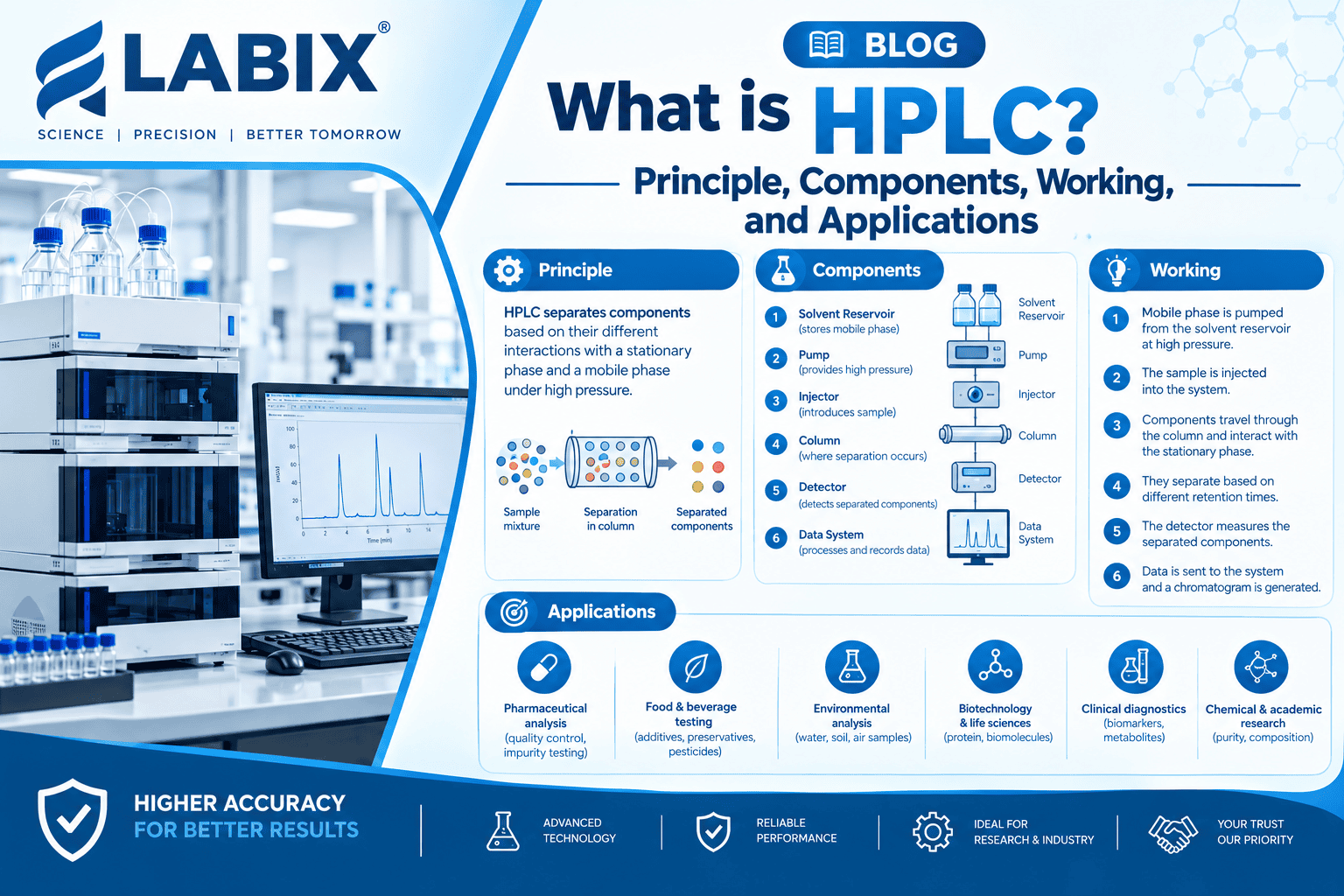
HPLC stands for high-performance liquid chromatography. It is an analytical technique that separates, identifies, and measures the components of a liquid mixture by pushing the sample through a packed column under high pressure. Pharmaceutical, food, environmental, and research laboratories use it every day for qualitative and quantitative analysis. This guide explains what HPLC is, its principle, the main HPLC components, how the process works step by step, the common types, and where it is used.
What Is HPLC?
HPLC is a form of liquid chromatography. In any chromatography method, a mixture is separated because its components move at different speeds through two phases. In HPLC, the mobile phase is a liquid (a solvent or a mixture of solvents), and the stationary phase is a solid material packed inside a metal column.
Older gravity-fed column chromatography is slow and gives limited separation. HPLC uses fine particles in the column and a pump to force the mobile phase through at high pressure. This gives faster runs, sharper peaks, and better separation. The technique is sometimes called high-pressure liquid chromatography, but “high-performance” is the standard term in most textbooks and pharmacopoeias.
HPLC works for compounds that dissolve in a liquid, which makes it suitable for many drugs, vitamins, preservatives, and other substances that are difficult to analyze by other methods.
Principle of HPLC
The principle of HPLC is based on how strongly each compound in a mixture interacts with the stationary phase compared with the mobile phase.
- A compound that interacts weakly with the stationary phase spends more time in the mobile phase, so it moves quickly and leaves the column first.
- A compound that interacts strongly with the stationary phase is held back, so it moves slowly and leaves the column later.
Because every compound interacts a little differently, they leave the column at different times. The time a compound takes to reach the detector after injection is called its retention time. The detector records a signal over time, and the result is a graph called a chromatogram, with one peak for each compound.
A simple way to picture it is a race where each runner has a different speed on the same track. Even if they all start together, they finish one after another.
The retention time helps identify a compound when compared with a known standard. The peak area or height is used to find how much of the compound is present, so HPLC supports both identification and quantification.
Main Components of an HPLC System
An HPLC instrument has several connected parts, and each one affects the quality of the result. Together they form the flow path of the system, which runs from the solvent to the data system. These are the main HPLC components.
Mobile Phase Reservoir and Degassing
The analyst stores the mobile phase in solvent bottles and usually filters and degasses the solvents before use. Filtration removes particles that could block the system, while degassing removes air bubbles that could disturb the flow and cause an unstable baseline. The analyst should follow the instrument manual because degassing methods vary by system.
Pump
The pump delivers the mobile phase through the system at a steady, controlled flow rate and high pressure. Two key pump parameters are the flow range (in ml/min) and the maximum pressure. A stable, pulse-free flow is important because even small changes in flow can shift retention times. Many pumps use a double-piston design to keep the flow steady. For example, the HPLC system LBX-655 from LABIX Industries lists a double-piston delivery method, a flow range of 0.001–9.999 ml/min, and a maximum pressure of 6000 psi.
Injector
The injector introduces a small, measured amount of sample into the flowing mobile phase. Manual injectors use a sample loop that is filled and then switched into the flow path. Automatic injectors, called autosamplers, do the same task for many samples in sequence. The LBX-655 page lists a Rheodyne injector among its accessories.
Column
The column is where the separation happens.It is a column packed with stationary-phase particles. Its length, diameter, and particle size all influence separation efficiency. One of the most commonly used stationary phases is C18, which consists of 18-carbon chains bonded to silica particles and is widely used in reverse-phase HPLC.
. Many labs also fit a short guard column before the main column to protect it from contamination.
Detector
The detector senses compounds as they leave the column and converts the signal into an electrical output. The most common type is the UV/visible detector, which measures how much light a compound absorbs at a chosen wavelength. Other detector types include fluorescence, refractive index, and mass spectrometer detectors, and the right choice depends on the compound being analyzed. The UV detector on the LBX-655 page lists a wavelength range of 190–700 nm. If you would like to understand how absorbance-based measurement works in general, you can also read about UV-Vis spectrophotometers.
Data System
The data system is the computer and software that records the signal, draws the chromatogram, integrate the peaks and produce the report. Good integration settings matter, because peak area is what the final quantity is based on.
How HPLC Works: Step-by-Step
The exact method depends on the sample and the instrument, but the general workflow is the same.
- Prepare the mobile phase. Mix, filter, and degas the solvents.
- Prepare the sample. Dissolve the sample in a suitable solvent and filter it to remove particles.
- Equilibrate the column. Run the mobile phase through the column until the baseline is stable.
- Inject the sample. A small, measured volume is introduced into the flow.
- Separation. The mobile phase carries the sample through the column, where the components separate based on their interaction with the stationary phase.
- Detection. The detector records each compound as it leaves the column.
- Interpret the results. Read the chromatogram, compare retention times with standards and calculate the amounts from peak areas.
The analyst can keep the mobile phase composition constant throughout the run, a process called isocratic elution, or gradually change it during the run, a process called gradient elution. Analysts often use gradient elution when a sample contains compounds with very different properties. Always follow your validated method and the instrument manual for the actual operating conditions.
Types of HPLC
HPLC methods are grouped by the type of interaction used to separate the compounds.
| Type | Stationary / mobile phase | Typical use |
| Reverse-phase HPLC | Non-polar stationary phase, polar mobile phase | Most widely used type; many drugs and organic compounds |
| Normal-phase HPLC | Polar stationary phase, non-polar mobile phase | Compounds that dissolve poorly in water |
| Ion-exchange HPLC | Charged stationary phase | Ions, amino acids, proteins |
| Size-exclusion HPLC | Porous particles that separate by molecular size | Polymers, proteins |
In reverse-phase HPLC, the more polar compounds usually leave the column first, while less polar compounds stay longer. HPLC can also be analytical, which identifies and measures compounds, or preparative, which collects the separated compounds in larger amountsA related technique, UHPLC, uses smaller particles and higher pressure. Manufacturers provide separate documentation for UHPLC systems.
Applications of HPLC
HPLC is used wherever a liquid sample must be separated and measured accurately.
- Pharmaceutical analysis: checking the strength of active ingredients, detecting impurities, and running stability studies
- Food and beverage testing: measuring vitamins, preservatives, sweeteners, and additives
- Environmental monitoring: detecting contaminants in water and soil samples
- Biotechnology and clinical research: analyzing proteins, peptides, and other biomolecules
- Quality control: routine testing of raw materials and finished products in industry
LABIX Industries’ HPLC product page lists pharmaceuticals, biotechnology, environmental monitoring, and food safety testing among the application areas of its system. If you work in drug testing, you may also want to look at other pharmaceutical testing equipment used alongside HPLC in quality control labs.
Things to Consider When Choosing an HPLC System
Buying an HPLC system is a long-term decision, so compare systems against the methods you actually run. Useful points to check include
- Flow range and pressure rating of the pump
- Detector type and wavelength range
- Injection method, manual or automatic
- Software and data handling features
- Analytical or preparative requirements
- Service, spare parts and training support
Always review the product datasheet and ask the supplier whether the system suits your method. If you are comparing options, you can view the HPLC systems offered by LABIX Industries.
Frequently Asked Questions
What is the full form of HPLC?
HPLC stands for high-performance liquid chromatography. You may also see it called high-pressure liquid chromatography in older texts.
What is the difference between HPLC and GC?
HPLC uses a liquid mobile phase, while gas chromatography (GC) uses a gas. HPLC works well for compounds that dissolve in a liquid and do not vaporize easily, while GC works well for compounds that can be vaporized without breaking down.
What is the difference between isocratic and gradient elution?
In isocratic elution the mobile phase composition stays the same during the run. In gradient elution it changes over time, which helps separate samples that contain very different compounds.
Why does HPLC use high pressure?
The column contains very small particles that improve separation but resist liquid flow. Therefore, the HPLC pump generates high pressure to push the mobile phase through the column at a suitable flow rate.
Why must HPLC solvents be filtered and degassed?
Filtering removes particles that can block the column or tubing, and degassing removes dissolved air that can form bubbles and disturb the flow and the baseline. Follow the instrument manual for the recommended method.
What is retention time in HPLC?
Retention time is the time between sample injection and the peak appearing on the chromatogram. It is used to help identify a compound by comparing it with a known standard run under the same conditions.
Conclusion
HPLC is a powerful, widely used technique for separating and measuring compounds in liquid samples. Its principle is simple: compounds interact differently with the stationary and mobile phases, so they leave the column at different times. A system is made of a pump, injector, column, detector, and data system, and each part must work well for reliable results. When choosing or using HPLC equipment, match the specifications to your method and read the datasheet and manual carefully. To discuss your requirements, you can browse the HPLC range at LABIX Industries or send an enquiry to the team.

Add comment