
Introduction
Sugar concentration measurement using a polarimeter is a useful analytical method for studying sucrose solutions and other optically active substances. A polarimeter measures the angle through which a sample rotates plane-polarized light. Under controlled conditions, this optical rotation helps laboratories assess sugar concentration.
The technique is used in sugar processing, food and beverage testing, pharmaceutical analysis, and scientific research. However, reliable results depend on factors such as sample preparation, temperature, wavelength, measurement tube length, and the composition of the solution.
Laboratories can use a suitable polarimeter to study optical rotation and perform concentration measurements using an appropriate analytical method. This guide explains how polarimetry works, how to measure sugar concentration, where the method is useful, and how to avoid common measurement errors.
What Is Sugar Concentration Measurement Using a Polarimeter?
Sugar concentration measurement using a polarimeter is an analytical approach that uses optical rotation to estimate the concentration of an optically active substance, such as sucrose, in a solution.
Sucrose rotates plane-polarized light as the light passes through the solution. Under controlled conditions, the observed rotation depends on the sucrose concentration and the length of the sample tube, as well as the temperature and wavelength used for measurement.
Laboratories interpret this rotation using a suitable analytical procedure, calibration method, or reference data. The result depends on the method and sample composition, so polarimetry should not automatically be treated as a direct measurement of total sugar in every sample.
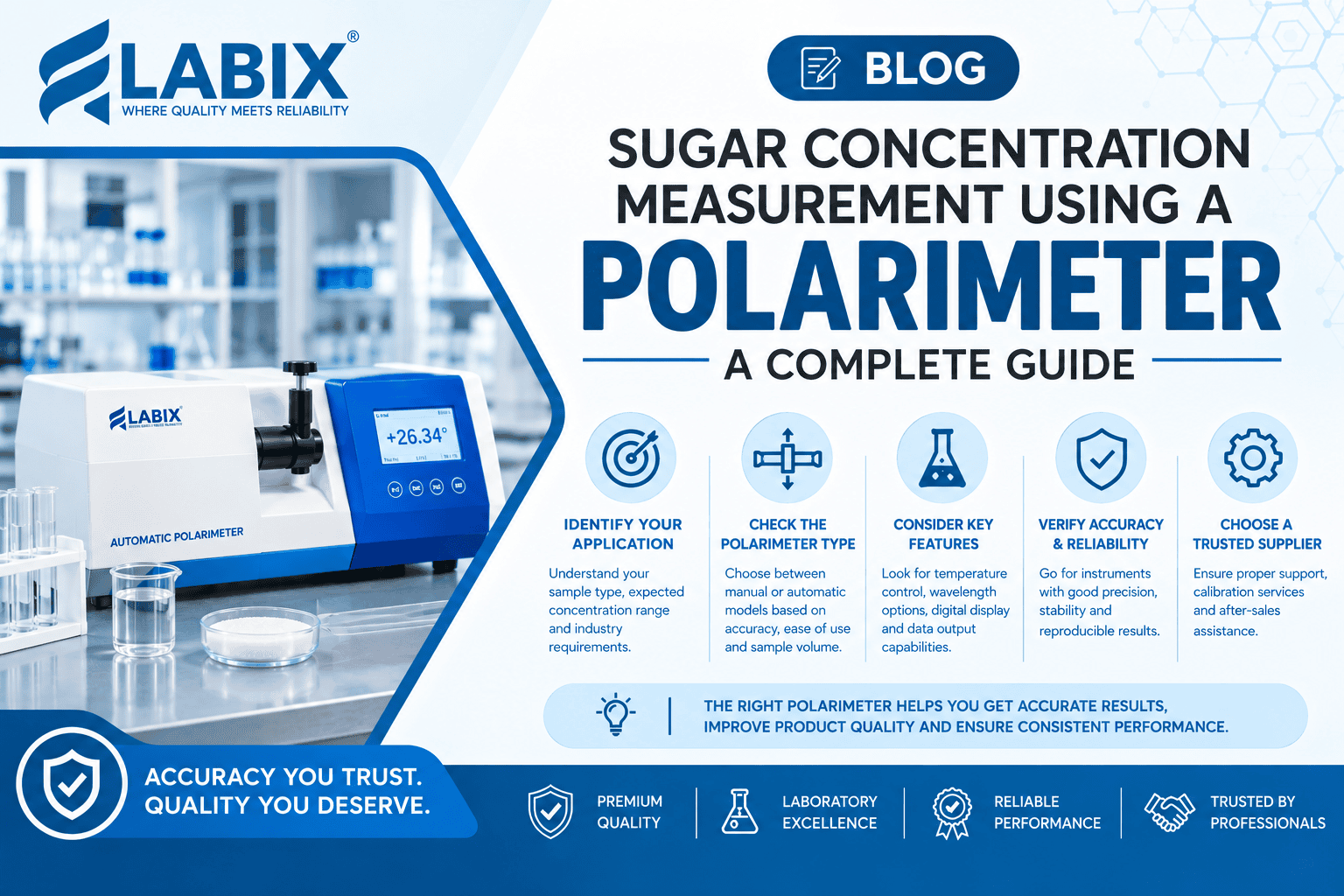
For laboratories that require optical rotation measurements, LABIX Industries offers an Automatic Polarimeter Touch Screen. The instrument’s listed measurement modes include optical rotation, specific rotation, sugar degree, and concentration. Laboratories should verify the instrument’s specifications and suitability for their particular testing method before selecting it.
What Is a Polarimeter?
A polarimeter is a scientific instrument designed to measure optical rotation. It typically includes a light source, a polarization system, a sample tube, an optical detection system, and a display or measurement scale.
Digital polarimeters can display measured values electronically. Depending on the model, they may also support specific rotation and concentration measurements through configured test modes.
Why Is Polarimetry Used for Sugar Analysis?
Polarimetry is useful when laboratories need to evaluate sucrose solutions or assess the optical activity of a sample. In the sugar industry, standardized polarimetric methods help determine sucrose content in raw materials, intermediate products, and finished sugar products.
The method can also support research and quality-control work in food, beverage, chemical, and pharmaceutical laboratories.
However, other optically active substances can influence the reading. Therefore, laboratories must select a suitable method and consider the sample composition before interpreting a result as sucrose concentration.
Principle of Polarimetry in Sugar Concentration Measurement
Polarimetry relies on the interaction between plane-polarized light and an optically active substance.
Ordinary light vibrates in multiple directions. A polarizer allows light with a defined polarization direction to pass through. When the polarized light travels through a sucrose solution, the solution rotates its polarization direction. The polarimeter measures this change as an angle of rotation.
How Does Sucrose Rotate Polarized Light?
Sucrose is optically active because of its molecular structure. When plane-polarized light passes through a sucrose solution, the solution rotates the plane of polarization.
Sucrose generally produces positive optical rotation under conventional measurement conditions. The measured angle usually increases with concentration and optical path length when other conditions remain constant and the method is applied within its appropriate range.
This relationship allows laboratories to use optical rotation as an analytical indicator of sucrose concentration.
Factors That Affect Optical Rotation
Several factors influence polarimeter readings:
- Concentration: More concentrated sucrose solutions generally produce greater optical rotation under comparable conditions.
- Tube length: A longer optical path allows the light to interact with the solution over a greater distance.
- Temperature: Temperature can affect specific rotation and the final measurement.
- Wavelength: Optical rotation varies with the wavelength of the light used.
- Sample composition: Other optically active compounds may contribute to the measured rotation.
Controlling these factors helps laboratories produce consistent results and compare measurements reliably.
How to Measure Sugar Concentration Using a Polarimeter
A consistent testing procedure helps laboratories obtain meaningful and repeatable measurements. The exact steps depend on the instrument, sample type, and analytical method. Always follow the manufacturer’s instructions and applicable testing standards.
Step 1: Prepare the Sugar Solution
Prepare a representative sample using the required analytical procedure. If the sample is solid sugar, weigh the appropriate amount using a suitable balance and dissolve it in the specified solvent.
Follow the prescribed preparation method and final volume. If the solution contains suspended particles, turbidity, or impurities, determine whether filtration or clarification is appropriate for the method.
Record the sample mass, dilution, final volume, and other preparation details needed for interpreting the result.
Step 2: Prepare and Check the Polarimeter
Place the instrument on a stable surface and allow it to warm up if required. Select the specified wavelength, temperature setting, and measurement mode.
Check the instrument’s operating condition and complete any required zero-setting, calibration, or reference checks according to the manufacturer’s instructions.
A properly prepared instrument helps reduce errors before the sample measurement begins.
Step 3: Fill the Sample Tube
Clean the sample tube and inspect it for damage, residue, or contamination. Fill it with the prepared solution according to the instrument instructions.
Avoid air bubbles in the optical path because they can interfere with light transmission and affect the reading. Ensure the tube’s optical windows are clean, then position the tube correctly in the instrument.
Step 4: Measure Optical Rotation
Close the sample compartment if applicable and take the measurement. A digital polarimeter displays the measured angle, while a manual instrument requires the operator to follow its specified reading procedure.
Repeat the measurement when required by the method. If the readings vary beyond the acceptable limit, check the tube, air bubbles, temperature stability, instrument zero, and sample homogeneity before continuing.
Step 5: Interpret the Reading
Interpret the observed rotation using the appropriate method for the sample. Depending on the instrument and analytical procedure, the result may be used with reference data, a calibration curve, or a validated calculation to determine concentration.
If the sample has been diluted, account for the dilution factor. Do not assume that every optical rotation reading corresponds exclusively to sucrose, especially when testing complex mixtures.
Step 6: Record and Report the Result
Document the observed rotation, measurement temperature, wavelength, tube length, sample preparation, dilution factor, and analytical method.
Where required, record repeat measurements and identify the reference method used. Complete records help laboratory personnel understand the result and compare it with previous measurements or quality-control requirements.
Applications of Polarimeters in Sugar Testing
Polarimeters have several applications in laboratories and sugar-related industries.
Sugar Manufacturing and Quality Control
Sugar-processing facilities use suitable polarimetric methods to evaluate sucrose content at different production stages. Standardized testing supports process monitoring, product consistency, and quality-control decisions.
Commercial sugar analysis may require specific scales, sample preparation procedures, and corrections. A general laboratory concentration measurement is not automatically equivalent to a standardized sugar-industry purity or polarization result.
Food and Beverage Laboratories
Food laboratories may use polarimetry to study sucrose solutions and selected sugar-containing samples. The technique can support ingredient evaluation and research when the sample matrix and method are suitable.
Complex beverages and processed foods may contain other sugars, acids, and optically active ingredients. These substances can influence optical rotation, so polarimetry alone may not provide a specific measurement of total sugar.
Pharmaceutical and Research Laboratories
Polarimetry is also used to study optically active substances in pharmaceutical and chemical analysis. Researchers can measure optical rotation to investigate concentration, sample identity, and changes under defined conditions.
The appropriate method depends on the substance being analysed and the purpose of the test.
Factors to Consider When Selecting a Polarimeter
Choosing a polarimeter requires matching the instrument’s capabilities to the intended analytical procedure.
Measurement Range and Resolution
Check whether the instrument covers the expected optical rotation range and provides sufficient resolution for the required measurements. Resolution alone does not establish accuracy, so review the manufacturer’s stated specifications and verification procedures.
Temperature Control
Temperature can influence optical rotation. If the method requires controlled temperature, select an instrument or compatible arrangement that can maintain and monitor the required condition.
Wavelength and Measurement Tube
Confirm that the available wavelength matches the prescribed method. Choose a compatible sample tube with the required optical path length and capacity.
Ease of Operation and Data Recording
Digital displays, repeat-measurement functions, and suitable data-recording options can simplify routine laboratory work. For standardized testing, check whether the instrument’s documentation and data-handling features meet laboratory requirements.
Before purchasing, compare the instrument specifications with the actual test method. You can review the LABIX Industries polarimeter range to explore listed options and verify their suitability for your application.
Common Mistakes to Avoid During Polarimetric Sugar Analysis
Even a suitable instrument can produce misleading results if the testing procedure is inconsistent.
- Using an unsuitable reference method: Confirm that the method matches the sample and intended result.
- Ignoring dilution: Account for all applicable dilution factors when interpreting concentration.
- Leaving air bubbles in the tube: Fill the tube carefully and inspect the optical path.
- Ignoring temperature changes: Follow the method’s temperature requirements.
- Using a contaminated tube: Clean and rinse the tube according to the sample and instrument instructions.
- Assuming all rotation comes from sucrose: Other optically active substances may influence the reading.
- Confusing concentration with purity: A concentration result is not automatically equivalent to percentage by mass or commercial sugar polarization.
Careful preparation, consistent operating conditions, and suitable analytical methods help improve the reliability of sugar measurements.
Frequently Asked Questions
1. Can a polarimeter measure sugar concentration directly?
A polarimeter measures optical rotation. Sugar concentration can then be determined using a suitable calculation, calibration method, or configured instrument mode. The result depends on the instrument and the analytical procedure.
2. Which sugar is commonly measured using a polarimeter?
Sucrose is commonly analysed by polarimetry because it is optically active. Other sugars can also affect optical rotation, so a suitable method is necessary to interpret their contribution correctly.
3. Does temperature affect sugar concentration readings?
Yes. Temperature can affect specific rotation and therefore influence the measured result. Follow the method’s temperature requirements and apply any prescribed corrections.
4. What sample tube length should be used?
The required tube length depends on the instrument and analytical method. A 1 dm optical path is common in some laboratory calculations, but other lengths may be specified. Always follow the method and instrument instructions.
5. Is polarimetry suitable for measuring total sugar in every beverage?
No. Other sugars and optically active ingredients can contribute to the measured rotation. Complex samples may require a validated analytical method or another technique when the objective is to determine total sugar specifically.
6. How can laboratories improve polarimetric measurement accuracy?
Use a suitable instrument, prepare samples consistently, remove air bubbles, control temperature and wavelength, verify the instrument, and follow the prescribed measurement procedure.
Conclusion
Sugar concentration measurement using a polarimeter provides a practical way to evaluate sucrose solutions through optical rotation. Reliable results depend on understanding the measurement principle, preparing samples carefully, controlling temperature and wavelength, and using a suitable analytical method. Laboratories must also consider other optically active substances before interpreting a reading as sucrose concentration.
For laboratories evaluating analytical instruments, LABIX Industries offers polarimeter options for laboratory and industrial applications. Explore the Automatic Polarimeter Touch Screen and review its specifications to determine whether it meets your testing requirements.




Add comment