
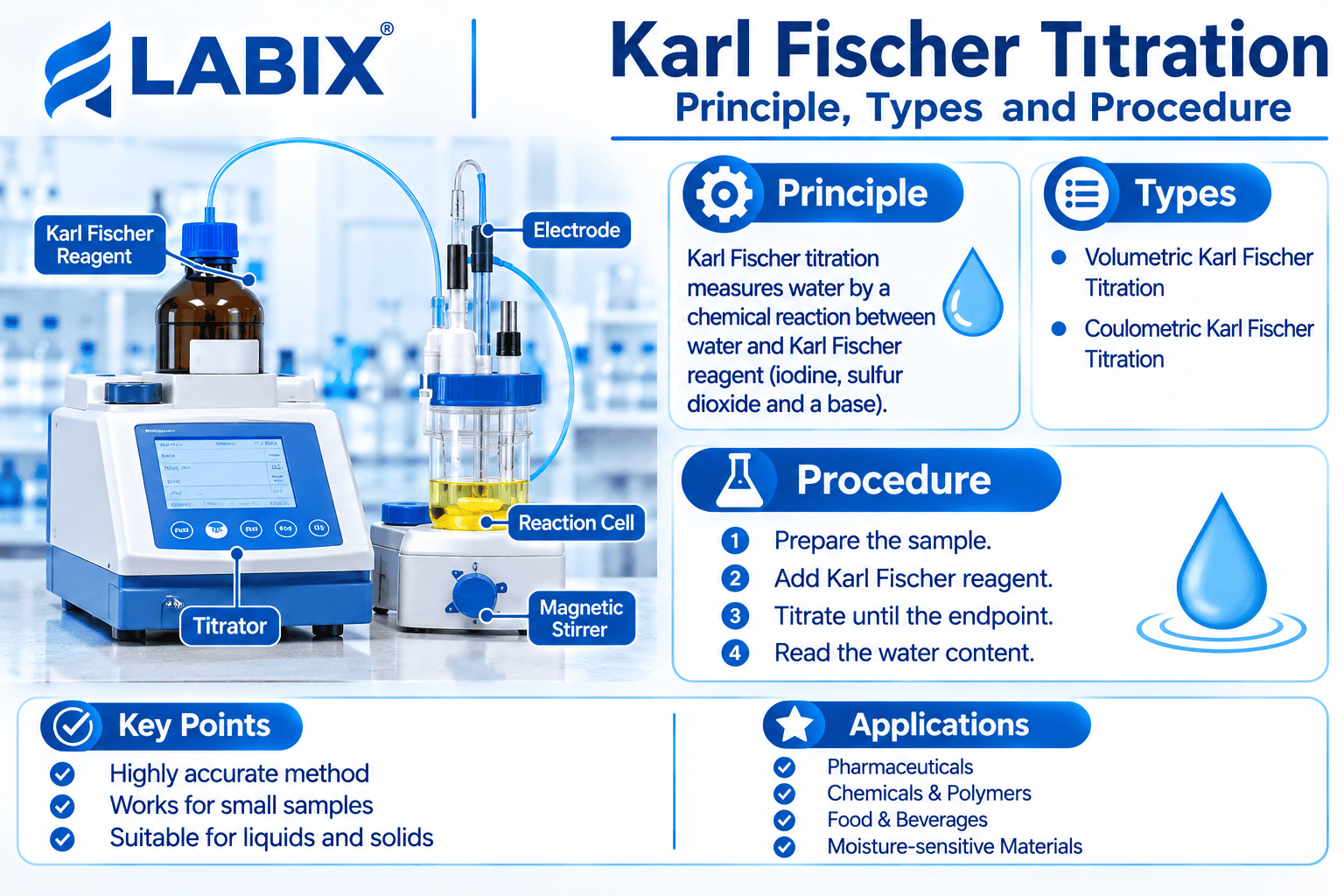
The Karl Fischer titration principle is simple to state: iodine reacts with water in a fixed 1:1 ratio, so measuring how much iodine a sample consumes reveals exactly how much water it holds. That precision matters in pharmaceutical quality control, chemical manufacturing, and food testing, where small moisture shifts affect stability and shelf life. LABIX Industries supplies Karl Fischer moisture titrators for pharmaceutical, chemical, and research laboratories, so this guide connects the chemistry to the instruments buyers actually evaluate.
Below, you will learn how Karl Fischer titration works, how the two main techniques differ, how to run the procedure, and how to choose suitable equipment. Quality control analysts, laboratory managers, and students will find practical steps and clear selection criteria.
What Is Karl Fischer Titration?
Karl Fischer titration is an analytical method that determines the water content of a sample by titration. German chemist Karl Fischer developed it in 1935, and it remains a reference technique because it responds to water specifically. Drying methods, by contrast, register any volatile loss. Analysts apply it to solids and liquids, and with suitable sample handling to gases, from active pharmaceutical ingredients and excipients to edible oils and solvents.
Every titration compares an unknown against a reagent delivered with known accuracy, and Karl Fischer work is no exception. Precise reagent delivery drives result quality, which is why the burette sits at the heart of volumetric systems. LABIX Industries explains the dispensing fundamentals in its guide to the burette, its parts, uses and types, and automatic dosing units build on those same principles.
Karl Fischer Titration Principle: The Chemistry Behind Water Detection
The reaction modifies the Bunsen reaction, in which iodine oxidises sulphur dioxide in the presence of water. In a Karl Fischer system, the reaction runs in an alcohol, usually methanol, with a base such as imidazole. The alcohol and sulphur dioxide form an alkyl sulphite, the base neutralises the acid produced, and iodine then oxidises the sulphite to alkyl sulphate while consuming water.
In simplified form, the overall reaction is: ROH + SO₂ + 3 RN + I₂ + H₂O → [RNH]SO₄R + 2 [RNH]I, where RN is the base.
One mole of iodine reacts with one mole of water. Because the ratio is fixed, the Karl Fischer titration principle lets the iodine consumed give the water mass directly. In coulometric work, roughly 10.71 coulombs of charge generate the iodine needed for each milligram of water.
How the Endpoint Is Detected
While water remains, iodine is consumed immediately, so the solution holds almost no free iodine. Once the water is exhausted, a slight excess of iodine appears. A double platinum electrode carrying a small constant current senses this change, and the voltage across the electrode pair drops sharply. The titrator reads that drop as the endpoint. This bipotentiometric detection is more objective than the visual colour changes used in older methods.
Karl Fischer Reagent: Components, Types and Handling
Karl Fischer reagent supplies the iodine, sulphur dioxide, base, and solvent that the reaction needs. Manufacturers offer it in two main forms:
• One-component reagent: All active ingredients sit in a single solution. The analyst adds it to a separate working solvent, commonly methanol, in the vessel. It is simple and widely used in routine volumetric work.
• Two-component reagent: The iodine titrant and the solvent containing sulphur dioxide and base are separate. Laboratories often choose this form when they need faster titrations or a more stable titer.
Reagent strength is expressed as a titer, usually in milligrams of water per millilitre of reagent. The titer changes as the reagent absorbs atmospheric moisture. Determine it with a water standard or sodium tartrate dihydrate, which contains 15.66% water, and repeat it as your procedure requires. Keep bottles tightly closed, protect them with a desiccant tube, and handle methanol-based reagents under ventilation, because methanol is toxic and flammable.
Volumetric vs Coulometric Karl Fischer: Which Technique Fits?
The key method decision is volumetric vs coulometric Karl Fischer. Both rely on the same chemistry, but they supply iodine differently, and that difference defines the water range each handles well.
Volumetric Karl Fischer Titration
A burette adds iodine-containing titrant to the cell until the endpoint. Volumetric titration suits samples with moderate to high water content, from roughly 100 ppm up to 100%. Typical examples include active ingredients, excipients, solvents, and many food ingredients.
The Microprocessor Karl Fischer Moisture Titrator Touch Screen (LBX-629) from LABIX Industries uses the Karl Fischer volumetric titration method. Its product page lists a motorised dispensing system, 0.01 ml titrant resolution, automatic titer calculation, and a measuring range of 10 ppm to 100% moisture. The accessories include a dual platinum electrode, and the unit has a built-in magnetic stirrer.
Coulometric Karl Fischer Titration
A coulometric cell generates iodine electrochemically at a generator electrode. Because the required charge is directly proportional to the amount of water present, according to Faraday’s law, this method needs no burette and no titrant standardisation. Moreover, it measures trace moisture accurately, typically from low ppm levels up to about 5%. As a result, laboratories widely use it to analyse lubricating oils, solvents and pharmaceutical materials where strict moisture limits apply. Overall, it is a reliable choice whenever precise moisture determination matters.
Samples with high water content would exhaust the electrolyte quickly.
| Feature | Volumetric | Coulometric |
| Iodine supply | Titrant dispensed from a burette | Generated electrochemically in the cell |
| Typical water range | About 100 ppm to 100% | Low ppm to about 5% |
| Titrant standardisation | Required | Not required for iodine generation |
| Best suited to | Moderate to high water content | Trace water content |
| Sample size | Larger samples | Very small samples |
Main Parts of a Karl Fischer Titrator
A Karl Fischer titrator combines hardware that keeps the system sealed from room air with electronics that detect the endpoint. Most systems include:
• Titration vessel: A sealed cell that holds the solvent and sample, with ports for the electrode, dosing tip, and sample entry.
• Dosing unit or generator electrode: A motorised burette in volumetric models, or an iodine-generating electrode in coulometric ones.
• Indicator electrode: A double platinum electrode that senses the endpoint.
• Magnetic stirrer: Disperses the sample quickly so water is released and titrated without delay.
• Drying tubes: Desiccant, such as calcium chloride, keeps atmospheric moisture out of the reagent and vessel.
• Control unit: Calculates results, stores data, and often connects to a printer.
How to Choose a Karl Fischer Titrator
Start with your application, then compare specifications against it. Consider these factors:
• Expected water range: Trace levels point toward coulometric operation, while higher levels point toward volumetric operation.
• Sample type: Solids, liquids, viscous materials, and gases each need suitable sample handling.
• Method requirements: Check that the instrument can follow the pharmacopoeial or internal method you use.
• Data handling: Look at result storage, printing, and connectivity.
• Running costs and maintenance: Include reagent use, desiccant replacement, electrode care, and service support.
• Operating conditions and budget: Confirm the room temperature and humidity limits the instrument allows.
As a reference point, the Karl Fischer Automatic Touch Screen (LBX-628) listed by LABIX Industries shows a testing scope of 0 µg to 200 mg, a sensitivity of 0.1 µg, colour touch-screen control, and storage for 1,000 test results. The page lists specimen forms as solid, liquid, and gas. It does not state the measuring method, so confirm that with the manufacturer before finalising a purchase. A Karl Fischer titrator is a precision instrument, so also request the manual and calibration guidance up front.
Karl Fischer Titration Procedure: Step-by-Step
The exact Karl Fischer titration procedure depends on your instrument and the method you follow, but this sequence applies to most volumetric analyses. Always follow your validated procedure and the instrument manual.
1. Prepare the system. Fill the reagent and solvent bottles, fit fresh desiccant, and check that the vessel, tubing, and septa are tight. Leaks admit moisture and raise drift.
2. Condition the cell. Add solvent and pre-titrate until the cell is dry and the drift is low and stable.
3. Determine the titer. Titrate a known amount of water standard or sodium tartrate dihydrate, then calculate the titer (F) in mg of water per ml of reagent.
4. Weigh the sample. Use a dry syringe or weighing boat, and record the mass accurately, ideally by difference.
5. Introduce the sample. Add it quickly to limit moisture pickup, and make sure stirring disperses or dissolves it.
6. Titrate to the endpoint. The instrument adds reagent until the endpoint stays stable for the set wait time.
7. Calculate the result. Water (%) = (V × F × 100) ÷ W, where V is the reagent volume in ml, F is the titer in mg/ml, and W is the sample mass in mg. Many instruments report this automatically in ppm, percent, or mg of water.
8. Repeat and verify. Run replicates, compare them with your acceptance criteria, and replace the solvent when the cell has absorbed enough sample.
Common Interferences and Troubleshooting
Aldehydes and ketones can react with methanol and produce water, which gives falsely high results, so use reagents formulated for them. Strongly acidic or basic samples push the pH outside the ideal range of roughly 5 to 7, so buffer them. Substances such as ascorbic acid, mercaptans, and peroxides can react with iodine or iodide. For samples that do not dissolve or release water slowly, an oven attachment, where the instrument supports it, carries water vapour to the cell in a dry gas stream. High, unstable drift usually signals leaks, exhausted desiccant, or wet solvent.
Karl Fischer Titration vs Moisture Balance
Laboratories often pair Karl Fischer titration with a moisture balance. A moisture balance heats the sample and reports weight loss. It is quick for routine checks, but it cannot separate water from other volatiles such as residual solvents. Karl Fischer titration measures water specifically, which is why pharmacopoeias such as the USP (general chapter <921>) and the European Pharmacopoeia describe Karl Fischer methods for water determination.
LABIX Industries lists a Digital Moisture Balance (Touch Screen) (LBX-645) with a 0–100% moisture range, 100 g capacity, 1 mg readability, a halogen heating source, and a 60 to 200°C temperature setting range. A common workflow uses such an instrument for fast routine screening, and reserves Karl Fischer titration for water-specific confirmation or low-moisture products.
Where Karl Fischer Titration Is Used
Pharmaceutical laboratories test active ingredients, excipients, and freeze-dried products, where moisture affects stability. Food and beverage laboratories check oils, confectionery, and dairy ingredients. Chemical and petrochemical laboratories monitor solvents and fuels, while research institutes use the method for reagent and material characterisation.
Frequently Asked Questions
How often should I standardise Karl Fischer reagent?
Determine the titer when you open a new reagent bottle, and then at the intervals your procedure sets, often daily. The reagent absorbs moisture over time, so its titer drifts.
Is Karl Fischer titration specific to water?
It is highly selective for water, but certain compounds, including some aldehydes, ketones, and reducing agents, interfere. Check your sample matrix against the reagent manufacturer’s guidance.
How do I analyse solids that do not dissolve?
Use a solvent that dissolves the sample, extract the water with an external solvent, or use an oven attachment that transfers released water vapour to the cell.
What causes high drift in the titration cell?
Leaking septa or tubing, spent desiccant, and wet solvent are the usual causes. Re-seal the system, replace the desiccant, and condition the cell again.
What safety precautions apply?
Wear gloves and eye protection, work with good ventilation, and keep reagents away from ignition sources. Follow the safety data sheet and your local rules for waste disposal.
Conclusion
Karl Fischer titration remains the standard approach for water-specific measurement because its stoichiometry is fixed and its endpoint detection is objective. Understanding the Karl Fischer titration principle helps you choose between volumetric and coulometric methods, prepare reagents properly, and troubleshoot drift. When comparing instruments, check stated measuring ranges, methods, and documentation against your own samples. LABIX Industries lists Karl Fischer titrators and moisture-analysis equipment for pharmaceutical and laboratory use. Review the product specifications, and contact the team with your sample type and water range before you decide.









Add comment