
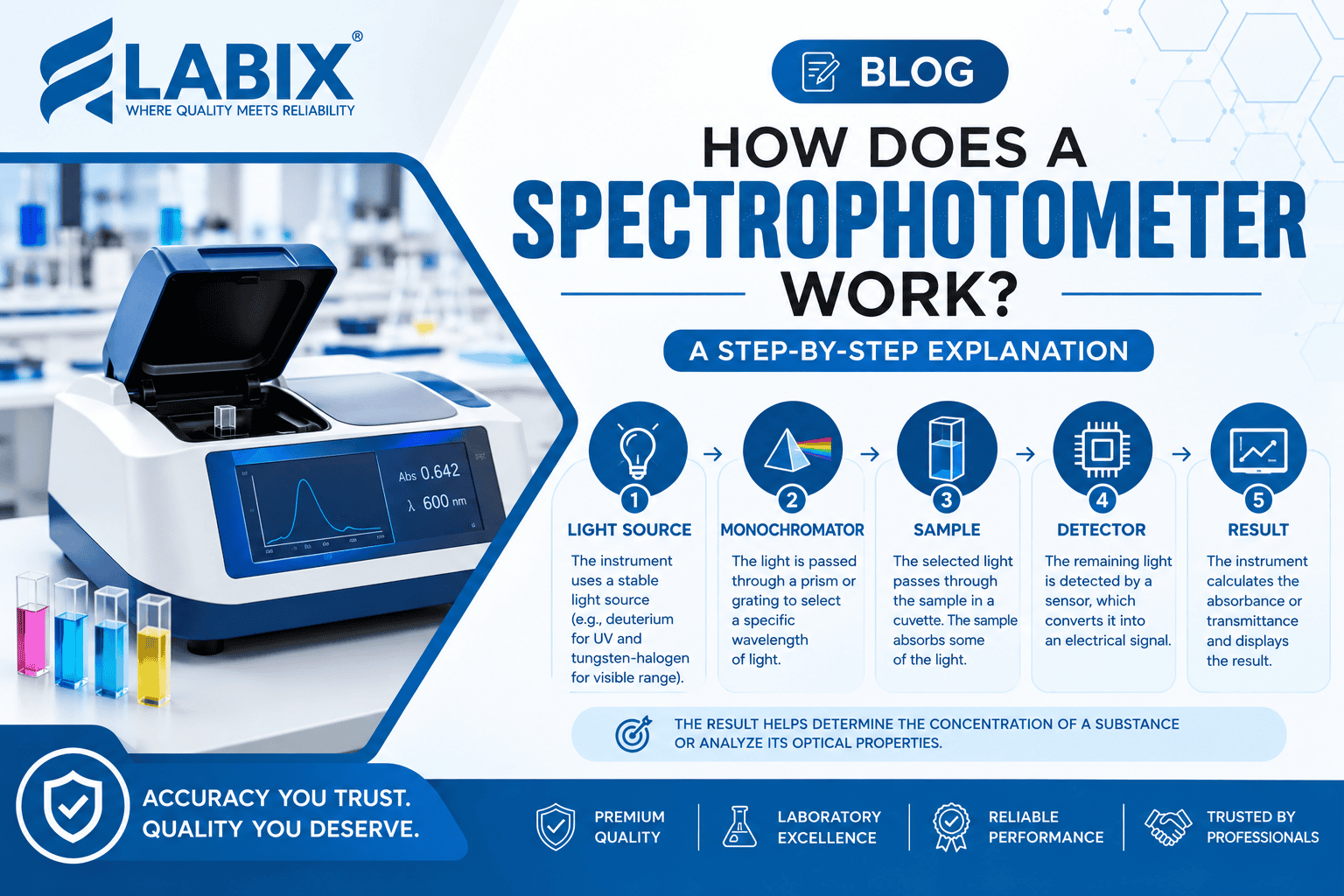
A spectrophotometer works by directing light of a selected wavelength through a sample and measuring how much light the sample absorbs or transmits. The instrument displays the result as absorbance or transmittance. Scientists use absorbance readings to determine a substance’s concentration in a solution.
If you want to understand how a spectrophotometer works in pharmaceutical, clinical, or teaching laboratories, the process involves four main stages. First, a light source produces light. Next, a monochromator selects a specific wavelength. The light then passes through the sample, and a detector measures the transmitted light to help determine the sample’s absorbance and concentration. This article walks through each stage, explains the science behind it and shows how different designs compare.
What Is a Spectrophotometer?
A spectrophotometer is an analytical instrument that measures how much light a sample absorbs or transmits at specific wavelengths. Because different substances absorb light differently, the measurement can be used to identify or quantify them in a solution.
Most laboratory instruments work in the ultraviolet (UV) and visible parts of the spectrum, which is why they are commonly called UV-Vis spectrophotometers. Two terms appear often in their readings:
- Transmittance (%T): the percentage of light that passes through the sample.
- Absorbance (A): a logarithmic measure of how much light the sample absorbs. It is the value most commonly used for quantitative work.
For a broader overview of instrument types and diagrams, see our guide on spectrophotometer types and working principle.
How a Spectrophotometer Works Step by Step
The measurement process follows the same basic path in almost every instrument.
Step 1 to 3: Light Source, Wavelength Selection and Sample
1. Light is produced. A lamp emits light across a range of wavelengths. Visible-range measurements commonly use a tungsten or halogen lamp, while UV measurements use a deuterium lamp. Some instruments use a xenon lamp, which gives a stable light output.
2. A wavelength is selected. The light enters a monochromator, usually built around a diffraction grating. It separates the light into its component wavelengths and allows only a narrow band, the one chosen for the measurement, to move forward.
3. The light passes through the sample. The selected light travels through a cuvette, a small transparent container holding the sample solution. Before measuring the sample, the user first measures a blank, which contains only the solvent. This sets the baseline so that only the effect of the substance of interest is recorded.
Step 4 to 5: Detection and Reading
4. The detector measures the remaining light. After passing through the sample, the light reaches a detector, which converts light intensity into an electrical signal. The more light the sample absorbs, the weaker this signal becomes.
5. The instrument calculates the result. Internal electronics or software compare the signal from the sample with the blank, calculate transmittance and absorbance, and display the result on a screen, a connected computer or as a spectrum plot.
A Simple Example
Suppose a laboratory wants to measure the colour intensity of a dye solution. The technician sets the wavelength where the dye absorbs strongly, measures a blank of pure solvent, then measures the dye sample. A darker solution absorbs more light and gives a higher absorbance reading.A spectrophotometer uses standard solutions with known concentrations to create a calibration curve. The instrument then uses the sample’s absorbance reading and this curve to determine the unknown concentration.
Main Components of a Spectrophotometer
Each stage above corresponds to a specific part of the instrument.
- Light source: Tungsten or halogen lamps cover the visible range, and deuterium lamps cover the UV range. Many UV-Vis instruments combine two lamps to cover the full range, and some use a xenon lamp.
- Monochromator: Selects the wavelength. Its quality affects spectral bandwidth and the sharpness of the measurement.
- Sample compartment and cuvette: Holds the sample at a fixed path length, commonly 10 mm. Quartz cuvettes are used for UV work because ordinary glass and plastic absorb UV light, while glass or plastic cuvettes usually suit visible-range measurements.
- Detector: Common types include photodiodes, photomultiplier tubes and CCD or diode arrays.
- Display and software: Shows readings, plots wavelength scans, and in many modern instruments supports kinetics, multi-wavelength and quantitative modes.
Exact lamp types, wavelength range and detector details differ by model, so always confirm them in the product datasheet or operating manual.
The Principle Behind It: Beer-Lambert Law
The spectrophotometer working principle is based on the Beer-Lambert law. In simple terms, the absorbance of a solution is directly proportional to three things:
- the concentration of the absorbing substance,
- the path length of light through the sample,
- the substance’s absorptivity at that wavelength.
The Beer-Lambert law expresses this relationship as A = ε × l × c, where A represents absorbance, ε represents molar absorptivity, l represents the path length of light through the sample, and c represents the sample’s concentration.
In practice, a laboratory prepares several standard solutions, measures their absorbance and plots a calibration curve. The absorbance of an unknown sample is then compared against this curve to find its concentration.
The law works best under certain conditions. Results can deviate when:
- the solution is too concentrated,
- the sample is cloudy or contains particles that scatter light,
- stray light reaches the detector,
- the wrong wavelength is selected.
Diluting the sample, filtering it and choosing the wavelength of maximum absorbance usually improve reliability.
Single Beam vs Double Beam Spectrophotometers
The same principle is built into different optical designs. The two most common are single beam and double beam.
How a Single Beam Spectrophotometer Works
A single beam spectrophotometer sends one beam of light along one path. The blank and the sample are measured one after the other, and the instrument compares the two readings. This design is simpler and often more compact, which makes it popular in teaching laboratories and routine testing. Its readings can be affected if the lamp output drifts between the blank and sample measurements.
How a Double Beam Spectrophotometer Works
A double beam spectrophotometer splits the light into two paths: one passes through the reference and the other through the sample. The detector compares both beams almost simultaneously, which helps correct for lamp fluctuations and makes the design well suited to wavelength scanning and demanding analytical work.
LABIX Industries lists both single beam and double beam UV-Vis models in its range of spectrophotometers, including variants with touch screens, xenon lamps and variable bandwidth. Specifications differ by model, so compare wavelength range, bandwidth and accuracy in the datasheet.
Note that atomic absorption spectrophotometers measure absorption by atoms in a flame or furnace and use a different principle from UV-Vis instruments.
Where Spectrophotometers Are Used
Because the technique is fast and adaptable, spectrophotometers appear across many fields:
- Pharmaceutical and quality control labs: concentration measurement and routine analysis, following the relevant pharmacopoeia or internal procedures.
- Clinical and biochemistry laboratories: colorimetric tests and enzyme assays.
- Water and environmental testing: measuring dissolved substances through colour-based methods.
- Food and beverage analysis: colour and concentration checks.
- Life science research: quantifying DNA, RNA and protein samples.
- Educational laboratories: teaching absorbance, concentration and the Beer-Lambert law.
Practical Tips for Accurate Readings
Even a good instrument can give poor results if it is used carelessly. A few habits make a real difference:
- Warm up the instrument for the time recommended in the manual so the lamp output stabilises.
- Always measure a blank with the same solvent and cuvette type as the sample.
- Keep cuvettes clean, free from fingerprints and scratches, and handle them by the frosted sides.
- Remove air bubbles from the sample before measuring.
- Use the right cuvette material: quartz for UV, glass or plastic for visible light.
- Check performance regularly using wavelength and absorbance verification as described in the manufacturer’s documentation.
When selecting an instrument, consider the wavelength range, spectral bandwidth, accuracy, sample type, software features and whether a single or double beam design suits your workload. For example, a variable bandwidth double beam model offers adjustable spectral resolution, which can matter for some applications.
Frequently Asked Questions
What is the working principle of a spectrophotometer?
A spectrophotometer works on the absorption of light. A selected wavelength passes through a sample, and the amount of light absorbed is measured. According to the Beer-Lambert law, this absorbance is related to the concentration of the substance in the solution.
What is the difference between absorbance and transmittance?
Scientists prefer absorbance for quantitative analysis because it shows a direct relationship with concentration within the appropriate measurement range.
Why is a blank used in a spectrophotometer?
A blank contains only the solvent and no analyte. Measuring it first sets the baseline and removes the effect of the solvent and cuvette, so the reading reflects only the substance being measured.
Can I use a plastic or glass cuvette for UV measurements?
Usually not.Standard glass and many plastics block UV light, so laboratories generally use quartz cuvettes for UV measurements.
Glass or plastic cuvettes normally suit the visible range. Always check the cuvette manufacturer’s specifications.
How do I choose between a single beam and a double beam spectrophotometer?
Single beam instruments are simpler and well suited to routine and teaching work. Double beam instruments offer better stability and are preferred when scanning or higher analytical demands are involved. Compare the wavelength range, bandwidth, accuracy and your application requirements in the product datasheets.
Conclusion
A spectrophotometer works by producing light, selecting one wavelength, passing it through a sample and measuring what the detector receives. The result, based on the Beer-Lambert law, links absorbance to concentration. Understanding each stage helps you use the instrument correctly and choose the right design for your work.
When comparing instruments, review the wavelength range, spectral bandwidth, beam design and software against your application, and confirm the details in the manufacturer’s documentation. You can explore LABIX Industries’ range of spectrophotometers to compare available models.





Add comment