
HPLC detectors determine what you can actually see in a chromatogram. Each one converts the compounds leaving the column into an electrical signal, so the wrong choice can hide small peaks, add baseline noise or limit what your method can measure. LABIX Industries, a laboratory equipment manufacturer and supplier in India, lists HPLC systems with a built-in UV detector for pharmaceutical and analytical laboratories, which makes detector selection a practical question for many of its buyers.
This guide explains how an HPLC detector works, compares the main detector types and sets out clear criteria for choosing one. It is written for analysts, laboratory managers, students and procurement teams who need usable guidance rather than a catalogue of jargon, and it flags clearly where published product specifications end and general technical advice begins.
What Is an HPLC Detector and What Does It Do?
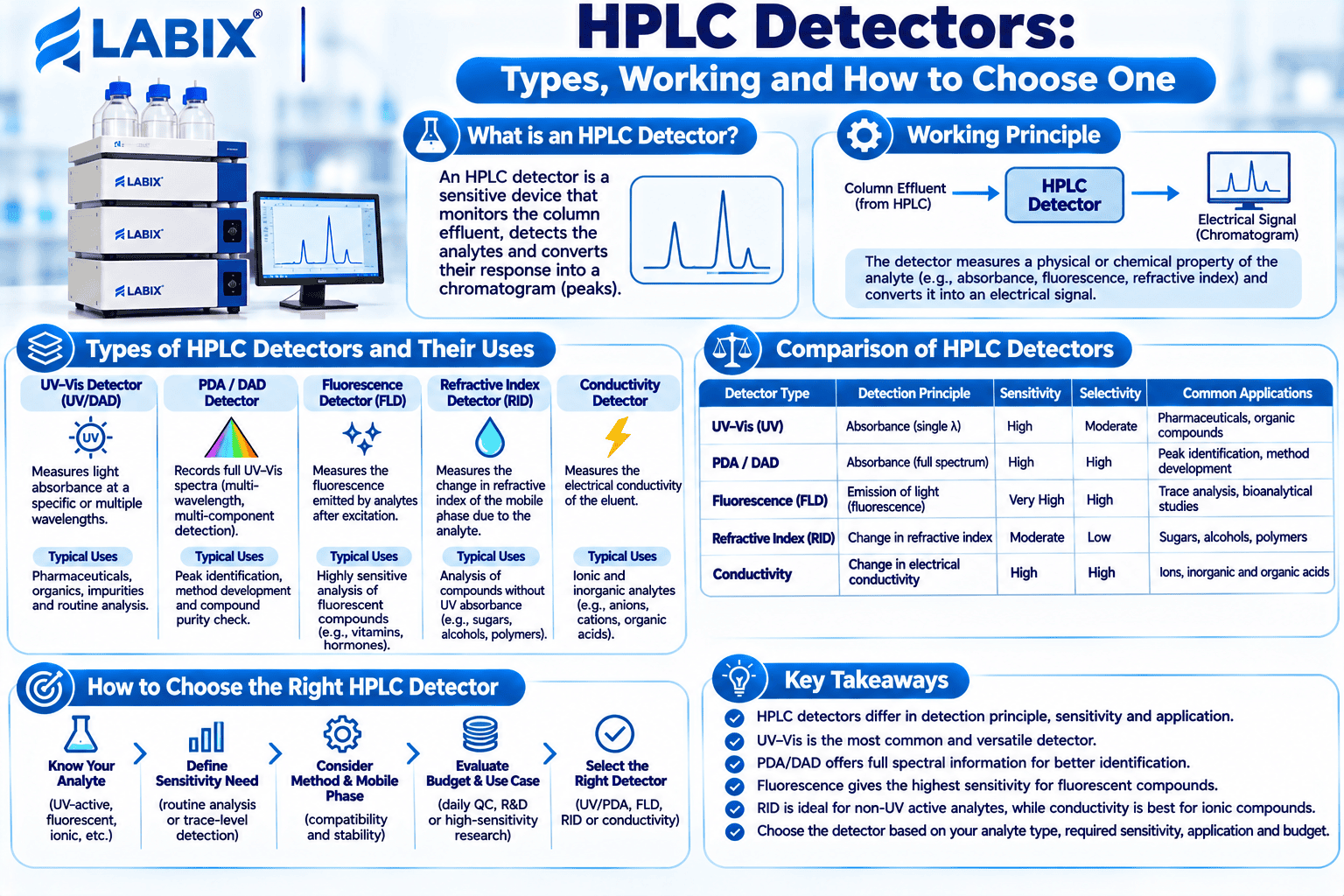
An HPLC detector is the component at the end of the column that senses each compound as it elutes with the mobile phase. A flow cell passes the eluent through a measuring zone, the detector records a property such as light absorbance, fluorescence or refractive index, and the data system plots that signal against time. The result is a chromatogram. Retention time helps identify a compound, while peak area or height supports quantification.
A good HPLC detector offers high sensitivity, a wide linear range, low noise and a small flow-cell volume, because a large cell causes band broadening and blurs closely eluting peaks. No single design excels at everything, so detectors differ in what they respond to. If you are still deciding whether liquid chromatography suits your sample at all, our comparison of HPLC vs GC explains where each technique fits best.
Types of HPLC Detectors at a Glance
The types of HPLC detectors fall into two broad groups. Selective detectors respond to a particular property, such as UV absorbance or fluorescence, and ignore many other compounds. Universal detectors respond to almost anything that elutes, but they usually give up some sensitivity or flexibility. The sections below cover the options most laboratories meet, and a comparison table follows them.
UV Detector in HPLC: How It Works
A UV detector in HPLC is the workhorse of pharmaceutical and routine quality-control laboratories. It shines ultraviolet or visible light through the flow cell and measures how much the analyte absorbs. According to the Beer–Lambert law, absorbance rises in proportion to concentration and path length, which gives a dependable basis for quantification. A deuterium lamp typically covers the ultraviolet range, and a variable-wavelength unit lets you set the wavelength where your analyte absorbs strongly.
Two practical limits apply. The analyte needs a chromophore, meaning a structure that absorbs light, and the mobile phase must stay transparent at the chosen wavelength, so solvent UV cut-off matters in gradient methods. Within those limits, UV detection is stable, sensitive and relatively economical.
The LBX-655 HPLC system from LABIX Industries lists a UV detector with a 190–700 nm wavelength range, 6 nm spectral bandwidth and a 10 µL flow cell. Its pump section lists a flow range of 0.001–9.999 mL/min and a maximum pressure of 6000 psi. These figures come from the published product page, so confirm the current configuration with LABIX before you buy.
PDA Detector: A Full Spectrum for Every Peak
A PDA detector, also called a diode array detector, passes polychromatic light through the flow cell and then splits it onto an array of photodiodes. Each diode records a different wavelength, so the instrument captures the whole spectrum at once instead of a single wavelength. You can extract chromatograms at several wavelengths from one injection and compare the spectrum across a peak to check peak purity or match it against a library.
That extra information helps in method development, impurity profiling and forced-degradation studies. The trade-offs are higher cost, larger data files and, in some configurations, slightly lower sensitivity than a single-wavelength UV detector tuned for one application. The LABIX HPLC product pages we reviewed describe a UV detector, so if your method depends on a PDA detector, ask the LABIX team to confirm availability and configuration.
Refractive Index Detector: The Universal Option
A refractive index detector measures the difference in refractive index between the column eluent and a reference stream of pure mobile phase. Because nearly every dissolved compound changes the refractive index, it works for analytes that lack a chromophore, such as sugars, polymers, glycols and some lipids. That universality makes it a common choice in food, polymer and carbohydrate analysis.
The limitations are significant. A refractive index detector is sensitive to temperature and pressure changes, needs a long warm-up to reach a stable baseline, and generally cannot be used with gradient elution because the changing mobile phase composition shifts the baseline. It is also less sensitive than UV or fluorescence detection, so it suits isocratic methods at moderate concentrations.
Fluorescence, ELSD and Mass Spectrometry Detectors
A fluorescence detector excites the analyte at one wavelength and measures the light emitted at a longer one. It offers excellent sensitivity and selectivity for naturally fluorescent compounds, or for compounds made fluorescent through derivatisation, which suits trace analysis of vitamins, aflatoxins and amino acids.
An evaporative light scattering detector (ELSD) nebulises the eluent, evaporates the mobile phase and measures the light scattered by the remaining solid particles. It works with gradients and detects non-volatile compounds without a chromophore, though its response is not linear over wide ranges and volatile analytes may be lost. Charged aerosol detectors follow a similar principle.
A mass spectrometer separates ions by mass-to-charge ratio and provides both sensitivity and structural information, which makes it valuable for identification and trace work. It also demands higher investment, volatile mobile-phase buffers and skilled operation.
HPLC Detector Types Compared
| Detector | Principle | Best suited for | Main limitation |
| UV-Vis | Light absorbance | Compounds with a chromophore; routine assay and impurity testing | Needs UV-active analytes and a transparent mobile phase |
| PDA | Absorbance across all wavelengths at once | Peak purity, method development, impurity profiling | Higher cost; large data files |
| Refractive index | Change in refractive index | Sugars, polymers, glycols | Isocratic only; temperature sensitive; lower sensitivity |
| Fluorescence | Light emitted after excitation | Trace analysis of fluorescent or derivatised compounds | Limited to fluorescent analytes |
| ELSD / CAD | Light scattering or charge on dried particles | Non-volatile compounds without a chromophore | Non-linear response; unsuited to volatile analytes |
| Mass spectrometry | Mass-to-charge ratio | Identification and trace analysis | High cost; needs volatile buffers |
How to Choose an HPLC Detector
Start with the analyte, not the catalogue. The following criteria narrow the choice quickly.
- Analyte properties: Check whether your compounds absorb UV light, fluoresce or do neither. This single question often rules detectors in or out.
- Sensitivity and detection limit: Match the lowest concentration you must quantify to the published noise and minimum detectable concentration, not to a general reputation.
- Gradient compatibility: If your method uses a gradient, avoid a refractive index detector and check the mobile-phase UV cut-off.
- Selectivity and information: Choose PDA or mass spectrometry when you need peak purity or identification, and a simple UV detector when you only need quantification.
- Flow cell and noise: Compare flow cell volume, noise and drift figures, since they control baseline quality and peak shape.
- Maintenance and lamp life: Ask about lamp replacement, flow cell cleaning and service access, because downtime costs more than a small price difference.
- Compliance and budget: Regulated laboratories need documented calibration and qualification support, while teaching and routine laboratories can often meet their needs with a well-specified UV detector.
UV detection also connects to a simpler instrument. Many analysts scan a standard solution on a UV-Vis spectrophotometer to find the wavelength of maximum absorbance before they set the HPLC method. LABIX Industries lists a double beam UV-Vis spectrophotometer in its spectrophotometer range, which laboratories commonly use for this kind of wavelength scouting and for routine absorbance work.
Buyers comparing configurations can also review the LBX-656 HPLC system. Its published flow range, pressure limit and UV wavelength range match those of the LBX-655, so confirm accessories, options and the intended application directly with LABIX.
Common HPLC Detector Problems and Care
Most detector complaints trace back to a few causes. Air bubbles in the flow cell create spikes and noisy baselines, so degas solvents and purge the system. Baseline drift often follows temperature changes or a mobile phase that has not equilibrated. An ageing lamp loses energy and raises noise, and a contaminated flow cell reduces sensitivity until it is flushed with suitable solvents. Use HPLC-grade solvents, filter samples and buffers, and follow the manufacturer’s maintenance schedule and lamp-hour guidance. Regular wavelength and noise checks help you catch problems before they affect results.
Frequently Asked Questions
What is the most common HPLC detector?
The UV-Vis detector is the most widely used, particularly in pharmaceutical and quality-control work, because many drugs and impurities absorb ultraviolet light and the detector is stable, sensitive and economical.
Can a refractive index detector run gradient methods?
Generally no. Changes in mobile phase composition shift the refractive index and cause a drifting baseline, so refractive index detectors are normally used with isocratic methods.
What is the difference between a UV detector and a PDA detector?
A UV detector measures absorbance at one or a few selected wavelengths. A PDA detector records absorbance across a wide wavelength range simultaneously, giving a full spectrum for each peak and supporting peak purity checks.
Which detector suits compounds without a chromophore?
Refractive index, ELSD, charged aerosol and mass spectrometry detectors can all detect such compounds. The right option depends on whether you use gradient elution, how sensitive the method must be and whether the analytes are volatile.
How often should an HPLC detector lamp be replaced?
There is no universal interval. Lamp life depends on the lamp type, operating hours and instrument design, so follow the manufacturer’s guidance and replace the lamp when energy checks or baseline noise show that it is declining.
Conclusion
The right HPLC detectors match your analyte, method and compliance needs. UV detection covers most routine pharmaceutical work, a PDA detector adds spectral confidence, a refractive index detector handles compounds without a chromophore in isocratic methods, and fluorescence, ELSD and mass spectrometry serve more specialised needs. Review published specifications, check gradient compatibility and plan for maintenance before you commit. LABIX Industries supplies HPLC systems with UV detectors for pharmaceutical and analytical laboratories, so review the LBX-655 and LBX-656 pages or contact the LABIX team to discuss your application and detector requirements.

Add comment