
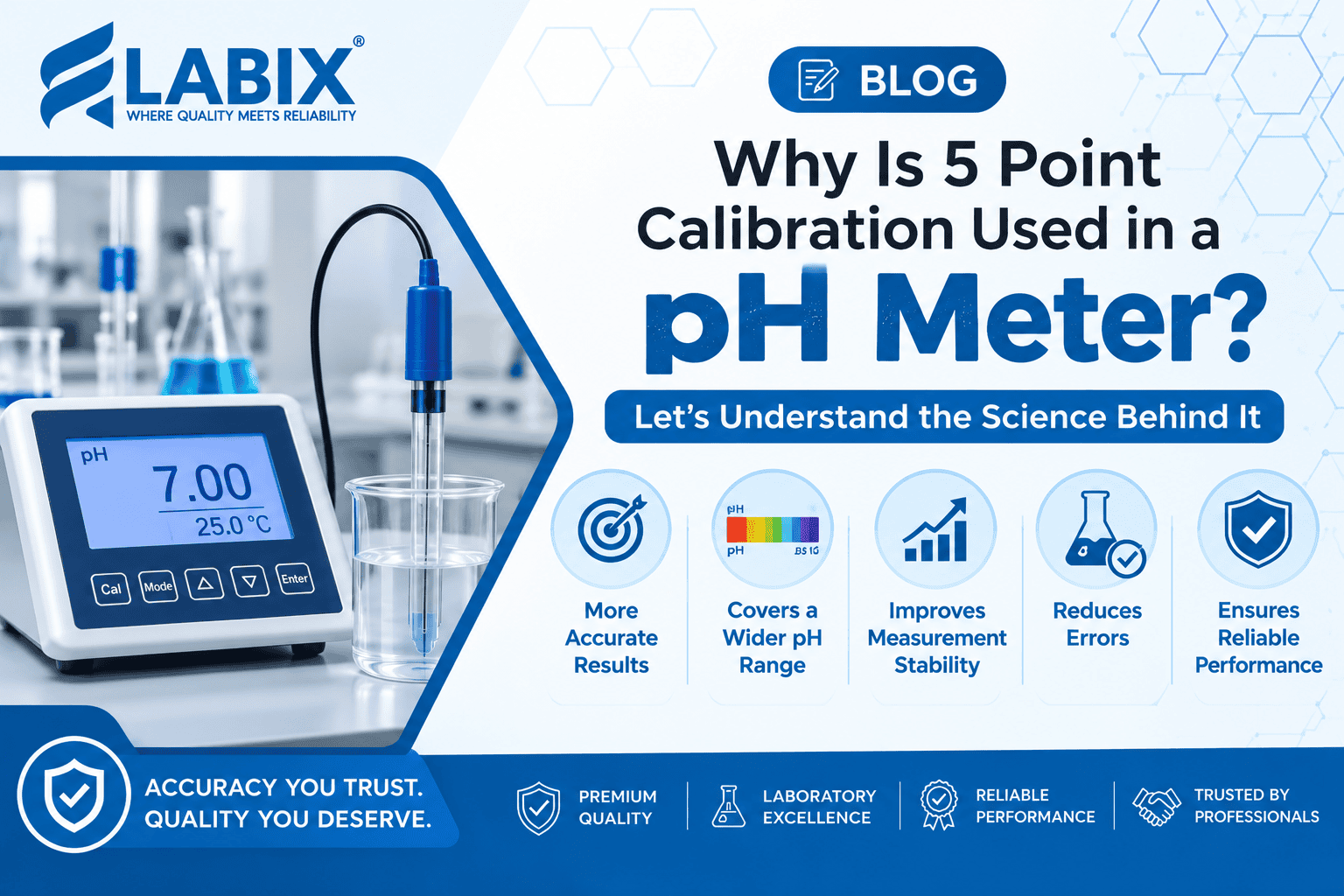
Five-point calibration is used in a pH meter to establish its response at five selected pH buffer values across a wider measurement range. It can be useful when laboratories measure samples with different acidity and alkalinity levels or when an analytical procedure requires calibration at multiple points. However, five-point calibration is not necessary for every application. The appropriate calibration method depends on the instrument, electrode condition, expected sample pH, and laboratory requirements.
Understanding why five-point pH meter calibration is used helps laboratory technicians, researchers, and quality-control professionals select suitable calibration settings and maintain reliable measurements.
What Is pH Meter Calibration?
pH meter calibration is the process of establishing or adjusting an instrument’s response using buffer solutions with known pH values. The meter uses these reference values to interpret the electrical response generated by the pH electrode and display a pH reading.
A pH electrode responds to hydrogen-ion activity in a solution through an electrochemical potential. The meter converts the measured electrical signal into a pH value based on its calibration and operating settings.
Calibration is important because electrode response can change with ageing, contamination, prolonged use, unsuitable storage, and other conditions. A suitable calibration helps the instrument account for certain changes in electrode response.
Two characteristics commonly associated with pH electrode calibration are:
- Slope: Describes how the electrode’s potential changes with pH.
- Offset: Describes the electrode’s response relative to the expected reference response around a calibration point.
Depending on the instrument, calibration results may be displayed as electrode slope, millivolt offset, calibration status, or other diagnostic information.
Calibration should not be confused with verification. Calibration establishes the instrument’s response using reference buffers, while verification involves checking performance against a suitable reference after calibration or at another point in the measurement process.
Why Is 5 Point Calibration Used in a pH Meter?
Five-point calibration is primarily used to establish a pH meter’s response at multiple reference points across a selected pH range. Its value depends on how the instrument will be used and which samples the laboratory needs to measure.
1. To Cover a Wider pH Measurement Range
Laboratories do not always work with samples that have similar pH values. Some samples are acidic, others are close to neutral, and others are alkaline.
Five-point calibration can provide calibration coverage across a broader range when the selected buffers and instrument support that range. This can be useful for laboratories that routinely test samples with substantially different pH values.
However, the selected buffer values should match the expected sample range. Using five points that do not cover the relevant measurement range may provide little practical benefit.
2. To Establish the Electrode Response at More Reference Points
A pH meter uses the electrode’s electrical response to determine pH. Calibrating at multiple buffer values provides additional reference points for establishing that response.
Some instruments use the calibration points to establish or assess the electrode’s response according to their internal calibration procedures. Depending on the model, the meter may also display slope, offset, or other calibration diagnostics.
Additional calibration points do not automatically guarantee better results. Buffer quality, electrode condition, temperature, instrument design, and the measurement method remain important.
3. To Support Laboratories with Different Sample Types
A laboratory may analyse water, chemical solutions, process samples, or other materials that fall within different pH ranges. When the measurement workload spans a broad range, five-point calibration may be appropriate if the instrument and analytical procedures support it.
For example, a laboratory measuring both acidic and alkaline samples may need a calibration approach that covers the relevant range. The actual buffer values should be chosen according to the expected samples and the manufacturer’s instructions.
4. To Meet a Defined Laboratory Procedure
Some laboratory procedures or internal quality systems specify calibration requirements based on the measurement’s purpose and risk. A procedure may require multiple calibration points or particular buffers before samples are analysed.
In such cases, the laboratory should follow its approved method and instrument documentation rather than choosing the number of calibration points solely for convenience.
5. To Help Assess Calibration Performance
Where the instrument supports it, reviewing calibration results across multiple points can help the operator identify an unacceptable electrode response or a calibration that does not meet the instrument’s acceptance criteria.
This does not mean that five-point calibration detects every possible error. Independent checks, suitable buffer handling, correct sample preparation, and routine instrument care may still be necessary.
How Does Five-Point pH Meter Calibration Work?
The exact procedure varies by pH meter, electrode, and buffer system. The following steps explain the general approach; the instrument’s operating manual should always determine the actual procedure.
Step 1: Select Suitable Buffer Solutions
Choose calibration buffers that cover the expected pH range of the samples. Common reference values include pH 4, 7, and 10, but these are examples rather than a universal five-point set.
The five selected values must be compatible with the instrument’s supported buffer system. The buffer documentation should be checked for its specified pH value at the relevant temperature.
Step 2: Prepare the Electrode and Buffers
Inspect the electrode and prepare it according to the manufacturer’s instructions. Use suitable, uncontaminated buffer portions and follow the recommended rinsing and handling procedure.
Do not return used buffer to the original bottle. Carryover between buffers can alter their properties and affect calibration results.
Step 3: Calibrate at the Required Points
Follow the meter’s calibration mode and sequence. Place the electrode in the first buffer, allow the reading to stabilize as instructed, and complete the calibration step.
Repeat the process for the remaining supported buffer points. Some meters recognize buffers automatically, while others require manual selection or confirmation.
Step 4: Review Calibration Results
After calibration, review any slope, offset, status message, or other diagnostic information the instrument provides. Check that the results meet the manufacturer’s acceptance criteria and the laboratory’s procedure.
If the calibration fails, investigate possible causes rather than assuming that repeating the same procedure will solve the problem.
Step 5: Verify Performance When Required
Some procedures require checking the calibrated meter with a suitable buffer before sample analysis or at specified intervals. Follow the laboratory’s verification requirements and document the results where applicable.
A successful calibration is important, but it does not eliminate errors caused by unsuitable samples, contaminated electrodes, or incorrect measurement conditions.
Five-Point vs Two-Point and Three-Point pH Calibration
The main difference between these approaches is the number of buffer reference points used during calibration. The appropriate choice depends on the application rather than the number alone.
| Calibration method | General purpose | Potentially suitable for |
| Two-point calibration | Establishes the response using two buffer values | Routine measurements within a defined pH range |
| Three-point calibration | Uses a third buffer reference point | Applications needing additional calibration coverage across the intended range |
| Five-point calibration | Uses five supported buffer reference points | Applications requiring broader calibration coverage or following a procedure that specifies five points |
When Is Two-Point Calibration Enough?
Two-point calibration may be sufficient when the laboratory measures samples within a relatively narrow pH range and the instrument’s manual and analytical method permit it.
For example, a routine procedure that measures samples around a particular pH range may not benefit from using five calibration points every time. The laboratory should still select suitable buffers that bracket or otherwise appropriately cover the expected measurements, as required by its method.
When Should Three-Point or Five-Point Calibration Be Considered?
Three-point or five-point calibration may be appropriate when the sample range is broader, the method requires additional reference points, or the instrument provides calibration features intended for that workflow.
The final choice should account for the expected pH values, the consequences of measurement errors, the instrument’s capabilities, and the relevant procedure. More calibration points should not be treated as a substitute for proper technique or instrument maintenance.
Factors That Affect Five-Point Calibration Results
Using five buffers does not guarantee reliable pH readings. Calibration quality depends on several practical factors.
Buffer Quality and Handling
Contaminated, incorrectly stored, or unsuitable buffer solutions can compromise calibration. Use buffers that meet the requirements of the instrument and analytical method, and follow their storage and handling instructions.
Temperature
Buffer pH can vary with temperature. The electrode response can also change with temperature. Automatic temperature compensation, when available, addresses certain temperature-related aspects of measurement but does not correct every temperature effect or make temperature considerations unnecessary.
Electrode Condition
An electrode that is dirty, damaged, aged, or improperly stored may respond slowly or fail to meet the required calibration criteria. Follow the manufacturer’s recommendations for electrode cleaning, storage, and replacement.
Rinsing and Cross-Contamination
Residual buffer or sample carried from one solution to another may change the next solution’s composition. Follow the specified rinsing procedure and avoid contaminating buffer containers.
Stabilization and Calibration Acceptance
Readings should be allowed to stabilize according to the instrument’s instructions. Do not ignore calibration warnings or acceptance criteria simply because the meter displays a pH value.
If calibration repeatedly fails, consult the manual and investigate the electrode, buffers, temperature, and instrument settings.
When Is Five-Point Calibration Necessary?
Five-point calibration is not universally necessary. It is most relevant when the instrument supports the feature and broader calibration coverage is useful for the intended work.
Consider five-point calibration when:
- The laboratory routinely measures samples across a broad pH range.
- The analytical procedure specifies five calibration points.
- The instrument’s supported calibration system and buffer selection are suitable for the samples.
- The laboratory’s quality requirements call for this calibration approach.
A simpler calibration method may be suitable when the sample range is narrower and the method permits fewer points.
For example, a laboratory measuring samples within a limited pH range may be able to use two- or three-point calibration according to its approved procedure. Another laboratory that routinely measures both acidic and alkaline samples may need broader coverage.
In either case, the laboratory should use the calibration approach specified by its method and instrument documentation. The number of calibration points alone does not establish measurement accuracy.
How to Choose a pH Meter with Five-Point Calibration
When selecting a pH meter for laboratory work, check more than whether the instrument offers five-point calibration. The meter should suit the samples, measurement range, and working environment.
Consider the following factors:
- Calibration capability: Confirm the number of supported points and the available buffer-recognition options.
- Measurement range: Check the stated pH range and whether it matches the intended application.
- Accuracy and resolution: Review these specifications separately; resolution is not the same as accuracy.
- Temperature features: Check whether temperature measurement or compensation is available and appropriate for the method.
- Calibration diagnostics: Determine whether the meter displays electrode slope, offset, calibration status, or other useful information.
- Electrode compatibility: Confirm that the supplied or compatible electrode is suitable for the sample type.
- Data handling: Consider storage, connectivity, and reporting requirements where relevant.
LABIX Industries lists pH meters with five-point calibration functionality. For example, the Microprocessor pH Meter LBX-502 lists five-point calibration and automatic buffer recognition. The Microprocessor pH Meter LBX-503 also lists five-point calibration and automatic/manual calibration.
These features are specific to the respective models. Review each product’s published specifications and operating documentation before deciding whether it meets your laboratory’s requirements.
Frequently Asked Questions
Is five-point calibration more accurate than three-point calibration?
Not necessarily. Five-point calibration provides additional reference points, which may be useful across a broader pH range. Accuracy also depends on the electrode, buffer solutions, temperature, instrument, and analytical procedure.
Which buffer solutions are used for five-point pH calibration?
The appropriate buffer values depend on the instrument’s supported buffer system and the sample range. Common pH 4, 7, and 10 buffers are examples of calibration references, but they do not define a universal five-point set. Follow the instrument manual and laboratory procedure.
Can every pH meter perform five-point calibration?
No. Calibration capabilities vary by model. Check the manufacturer’s specifications to confirm the supported number of calibration points and buffer options.
How often should a pH meter be calibrated?
Calibration frequency depends on the instrument, electrode condition, sample type, measurement risk, and laboratory procedure. Follow the manufacturer’s instructions and any applicable quality requirements rather than relying on one frequency for every application.
Does automatic temperature compensation replace calibration?
No. Automatic temperature compensation and calibration serve different purposes. Temperature compensation does not remove the need for calibration or correct every temperature-related effect on a sample measurement.
What should I do if a pH meter fails five-point calibration?
Check the buffer condition, temperature, electrode cleanliness, stabilization, and instrument settings according to the manual. If the problem persists, follow the manufacturer’s troubleshooting instructions and investigate whether the electrode or instrument requires service.
Conclusion
Five-point calibration is used in a pH meter when calibration across multiple reference values can support the laboratory’s intended measurement range or when the relevant procedure requires it. It may be useful for samples with different acidity and alkalinity levels, but it does not automatically guarantee better accuracy than two- or three-point calibration. Buffer selection, electrode condition, temperature, and correct handling remain essential. Before selecting an instrument, review its calibration capabilities and operating requirements. Explore the LABIX Industries pH meter range to compare available models and identify features relevant to your laboratory’s needs.





Add comment