
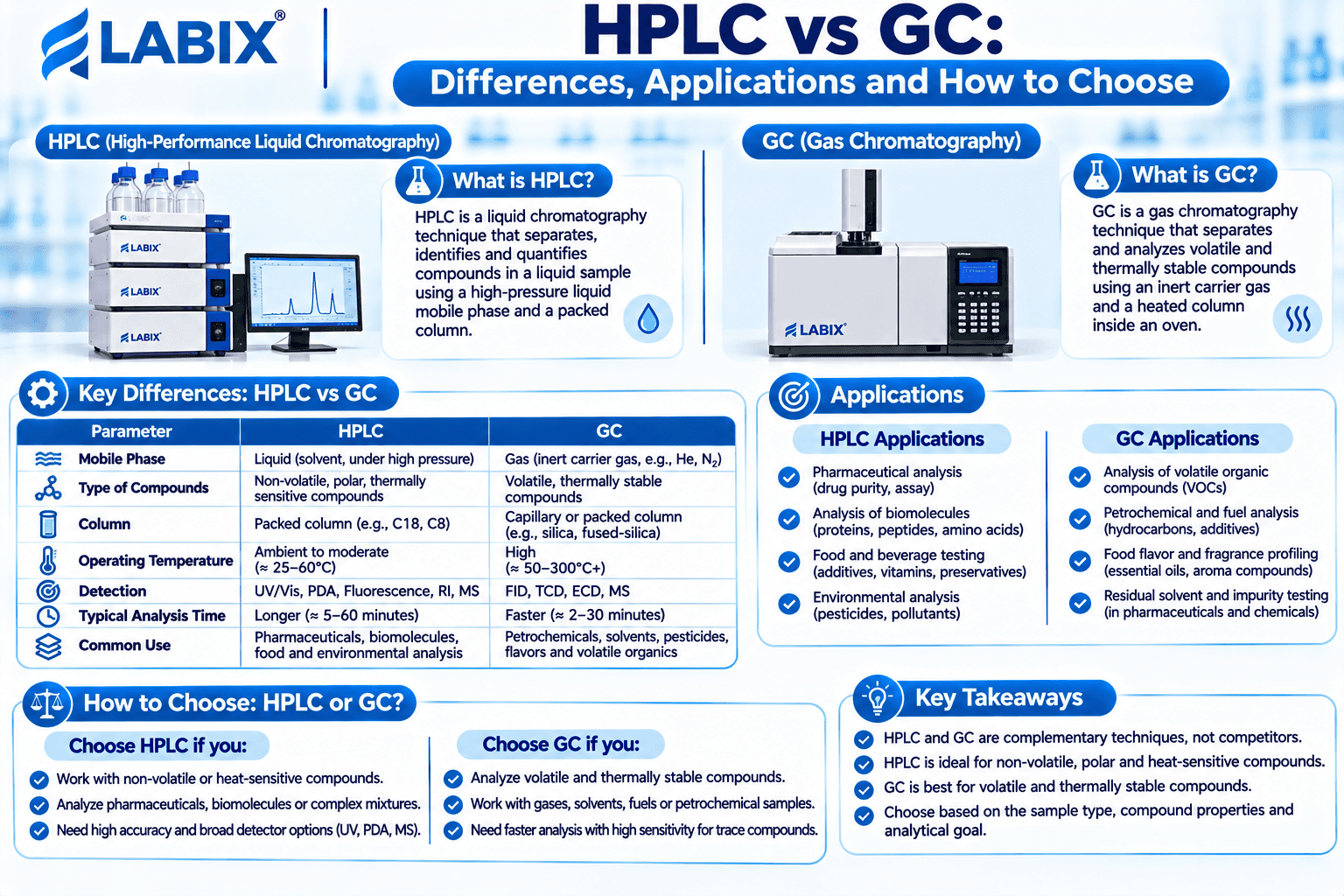
Choosing between HPLC vs GC is one of the most common decisions laboratory professionals face when setting up a new analytical method or upgrading existing capability. Both techniques separate complex mixtures into individual components, but they rely on different physical principles, equipment designs and sample requirements, which means the right choice depends heavily on what is being tested. LABIX Industries manufactures and supplies laboratory and pharmaceutical analytical instruments, including a high-performance liquid chromatograph (HPLC) system, that support laboratories working on pharmaceutical quality control, biotechnology research, environmental monitoring and food safety testing. Understanding how HPLC and gas chromatography (GC) compare on sample type, operating conditions and sensitivity helps equipment buyers and lab managers select instrumentation that matches their actual workflow rather than guessing based on familiarity alone.
What Is HPLC?
High-performance liquid chromatography, commonly known as HPLC, is an analytical separation technique. It uses a liquid mobile phase to carry a sample through a column under high pressure. The column contains a packed stationary phase. Each sample component interacts differently with this phase. As a result, compounds separate and elute at different times. A detector then identifies and quantifies each compound.
HPLC is widely used in pharmaceutical quality control, impurity profiling and assay testing. It also supports biomolecule analysis. This technique handles non-volatile, thermally unstable and large molecules that are difficult to analyze using other methods.
For a deeper technical breakdown of how the system works, our earlier guide, What is HPLC? Principle, Components, Working, and Applications, explains the pump, injector, column and detector components in more detail.
What Is Gas Chromatography (GC)?
Gas chromatography separates volatile compounds using an inert carrier gas, usually nitrogen, helium or hydrogen, that moves the sample through a column held inside a temperature-controlled oven. Because the technique depends on vaporizing the sample, it works best for compounds that are naturally volatile or can be made volatile without decomposing. Gas chromatography is a standard method in petrochemical analysis, residual solvent testing, environmental monitoring of volatile organic compounds, and food and beverage quality testing, where it offers fast run times and strong resolution for complex volatile mixtures.
Difference Between HPLC and GC: Key Technical Factors
The difference between HPLC and GC comes down to the physical state of the mobile phase and, as a result, the type of sample each technique can handle. The comparison below summarizes the practical distinctions laboratory teams should consider.
| Factor | HPLC | GC |
| Mobile phase | Liquid (water, buffers, organic solvents) | Inert gas (nitrogen, helium or hydrogen) |
| Sample type | Non-volatile, polar, thermally sensitive compounds | Volatile, thermally stable compounds |
| Operating principle | High-pressure pump pushes liquid through a packed column | Temperature-programmed oven vaporizes and carries the sample |
| Common detectors | UV-Vis, PDA, fluorescence | Flame ionization, thermal conductivity |
| Typical applications | Pharmaceutical assay, impurity profiling, biomolecules | Solvent residues, VOCs, petrochemical analysis |
Mobile Phase and Sample Compatibility
The most fundamental difference between HPLC and GC lies in the mobile phase. HPLC uses a liquid mobile phase, commonly mixtures of water, methanol, acetonitrile or buffers, which allows it to analyze polar, non-volatile and thermally sensitive compounds such as proteins, pharmaceutical actives and large organic molecules. GC uses a gas mobile phase, which restricts its use to compounds that can vaporize at achievable oven temperatures without breaking down.
Instrumentation and Operating Conditions
HPLC systems operate using a high-pressure pump to force the liquid mobile phase through a densely packed column, paired with a detector such as a UV detector to monitor eluting compounds. GC systems instead rely on a temperature-programmed oven and a carrier gas delivery system, with detectors such as flame ionization or thermal conductivity detectors used depending on the application.
Sensitivity, Resolution and Detection
Both techniques can achieve high sensitivity and resolution, but the choice of detector matters as much as the separation method itself. HPLC detectors such as UV-Vis and fluorescence detectors are well suited to compounds with chromophores, while GC detectors are generally tuned to volatile organics and trace gas analysis. Neither technique is universally more sensitive; matching the detector to the analyte usually matters more than the underlying separation technique.
HPLC vs GC Advantages: Strengths of Each Technique
Each method has advantages that make it the preferred choice for specific laboratory needs. Weighing HPLC vs GC advantages side by side helps teams justify equipment investment decisions based on actual testing requirements rather than habit.
HPLC Advantages
- Suitable for non-volatile, polar and heat-sensitive compounds
- Well suited to pharmaceutical actives, proteins and biomolecules
- No need to vaporize the sample, reducing degradation risk
- Multiple detector options (UV, PDA, fluorescence) support diverse applications
GC Advantages
- Faster analysis for volatile compound mixtures
- Strong resolution for complex hydrocarbon and solvent mixtures
- Generally lower solvent consumption compared with many HPLC methods
- Well suited to trace-level environmental and petrochemical testing
Laboratories handling pharmaceutical formulations, biotechnology samples or aqueous environmental matrices typically lean toward HPLC, while labs focused on solvents, fuels, pesticide residues or volatile organic compounds often rely on GC.
GC vs LC: Which Separation Approach Fits Your Application?
The broader comparison of GC vs LC, liquid chromatography, of which HPLC is the most common form, comes down to one central question: is the compound of interest volatile and thermally stable, or not? If a compound decomposes on heating or does not vaporize at reasonable oven temperatures, liquid chromatography is usually the more reliable approach. If a compound is naturally volatile and thermally stable, gas chromatography often delivers faster, sharper separations with simpler sample preparation. Many laboratories use both techniques side by side, applying GC for volatile organic testing and HPLC for pharmaceutical, biochemical and non-volatile compound analysis within the same facility.
How to Choose Between HPLC and GC for Your Laboratory
Match the Technique to Your Application Requirements
Start by identifying what you are actually testing. Pharmaceutical dissolution and assay testing, biomolecule characterization and non-volatile impurity profiling point toward HPLC. Residual solvent testing, volatile organic compound monitoring and petrochemical analysis point toward GC. Reviewing the relevant pharmacopoeial or regulatory test method for your product category is a reliable starting point before finalizing equipment specifications.
Consider Sample Volatility, Thermal Stability and Preparation
If your samples degrade under heat or cannot be vaporized without decomposing, HPLC is generally the safer choice. If your samples are naturally volatile and sample preparation can be kept simple, such as headspace or direct injection, GC may offer faster throughput.
Evaluate Accuracy, Flow Precision and Detector Options
For HPLC systems, check the flow rate range, delivery precision and detector wavelength coverage against your method requirements. For example, LABIX Industries’ HPLC System High Pressure Liquid Chromatograph offers a flow range of 0.001 to 9.999 ml/min with a UV detector covering 190 to 700 nm, suiting a broad range of pharmaceutical and biotechnology applications. Always verify that a system’s documented specifications align with your validated method parameters before purchase.
Factor in Maintenance, Calibration and Long-Term Operating Costs
Both HPLC and GC systems require regular maintenance, including column care, detector calibration and consumable replacement, such as septa, ferrules or pump seals. Request maintenance schedules, calibration intervals and spare-parts availability from the manufacturer before committing to a purchase, since downtime and consumable cost materially affect the total cost of ownership.
Budget and Facility Considerations
HPLC and GC systems vary in price depending on detector configuration, automation level and throughput requirements. Beyond the instrument itself, laboratories should budget for solvents, gases, columns, software and operator training, as well as proper storage for chromatography plates, reagents and accessories. For instance, LABIX Industries’ Chromatography Cabinet Wooden provides secure, organized storage for chromatography plates and reagents, helping laboratories maintain a tidy and efficient working environment around their analytical instruments.
Complementary Analytical Techniques Worth Considering
In some cases, HPLC or GC alone may not fully characterize a sample, particularly where structural confirmation is needed. Techniques such as Fourier Transform Infrared (FT-IR) spectroscopy are often used alongside chromatography to confirm functional groups and verify compound identity. LABIX Industries’ FT-IR Spectrometer is designed for molecular characterization across pharmaceutical, polymer and environmental applications, and can serve as a useful complement to chromatographic analysis within the same laboratory.
Frequently Asked Questions
Is HPLC more accurate than GC?
Accuracy depends on the application and the detector used rather than on the separation technique alone. HPLC and GC can both deliver high accuracy when the method is properly validated and the instrument is correctly calibrated for the specific analyte.
Can the same laboratory use both HPLC and GC?
Yes. Many pharmaceutical, environmental and petrochemical laboratories operate both systems, since they serve different sample types. HPLC handles non-volatile and thermally sensitive compounds, while GC is suited to volatile, thermally stable samples.
What is the main difference between HPLC and GC in terms of mobile phase?
HPLC uses a liquid mobile phase, while GC uses a gas mobile phase. This single difference drives most of the practical distinctions in sample compatibility, instrumentation and detector choice.
Does LABIX Industries supply gas chromatography systems?
LABIX Industries’ current chromatography-related offering includes HPLC systems and supporting equipment such as FT-IR spectrometers and chromatography storage cabinets. For gas chromatography systems, please confirm current product availability directly with our team, since the product range is updated periodically.
How often should chromatography equipment be calibrated?
Calibration frequency depends on the manufacturer’s recommendations, the regulatory framework your laboratory follows, and usage intensity. Reviewing the equipment’s documentation and your internal quality system is the most reliable way to set an appropriate schedule.
Conclusion
Choosing between HPLC vs GC ultimately depends on what you are testing: non-volatile, thermally sensitive or large molecules generally call for HPLC, while volatile, thermally stable compounds are often better suited to GC. Many laboratories benefit from having both capabilities, supported by complementary techniques such as FT-IR for structural confirmation. LABIX Industries supplies HPLC systems, FT-IR spectrometers and supporting laboratory accessories designed for pharmaceutical, research and testing environments. Before finalizing your equipment decision, compare validated method requirements against manufacturer specifications, and consult official product documentation or the LABIX Industries team for guidance suited to your specific application.

Add comment